

ADHD and anxiety in adults can overlap, making it harder to manage overwhelm, procrastination, emotional reactions, focus and time. This article looks at how the patterns can differ, offers practical CBT strategies for everyday tasks, and explains how structured online ADHD support can help you build systems that fit real life.
• How ADHD and anxiety can overlap
• How the cycle can affect daily tasks
• How to notice different patterns
You’ll find ways to notice what gets in the way, take a manageable first step and review what worked. These are practical tools for reflection, not a way to diagnose yourself. Structured CBT learning can also help you practise strategies for daily functioning at your own pace.
Key Takeaways
• ADHD and anxiety in adults can affect focus and follow through in different ways. Noticing when and where difficulties arise can offer useful clues.
• When a task feels unclear, choose one small first action and make it visible. This can reduce the pressure to do everything at once.
• Simple cues and brief reviews can support time awareness and help you adjust a plan when overwhelm or procrastination gets in the way.
• The Adult ADHD Foundations Program™ offers structured, 100% online, self paced CBT learning to help adults practise practical systems for daily life.
How ADHD and anxiety in adults can overlap without being the same
Overwhelm, procrastination, emotional reactivity, difficulty focusing and trouble managing time can make everyday life feel harder. These experiences may occur with ADHD, anxiety, both, or other circumstances. Noticing them is a starting point for understanding your patterns, not a way to diagnose yourself.
ADHD is linked with differences in attention, activity and impulse control. It can affect planning, organising and getting started, even when a task matters. Anxiety involves worry or fear that can feel difficult to switch off, sometimes with a sense that something may go wrong. The Adult Attention Deficit Hyperactivity Disorder overview describes ADHD and the ways it can occur alongside other difficulties. Having experiences in common does not mean one condition caused the other.
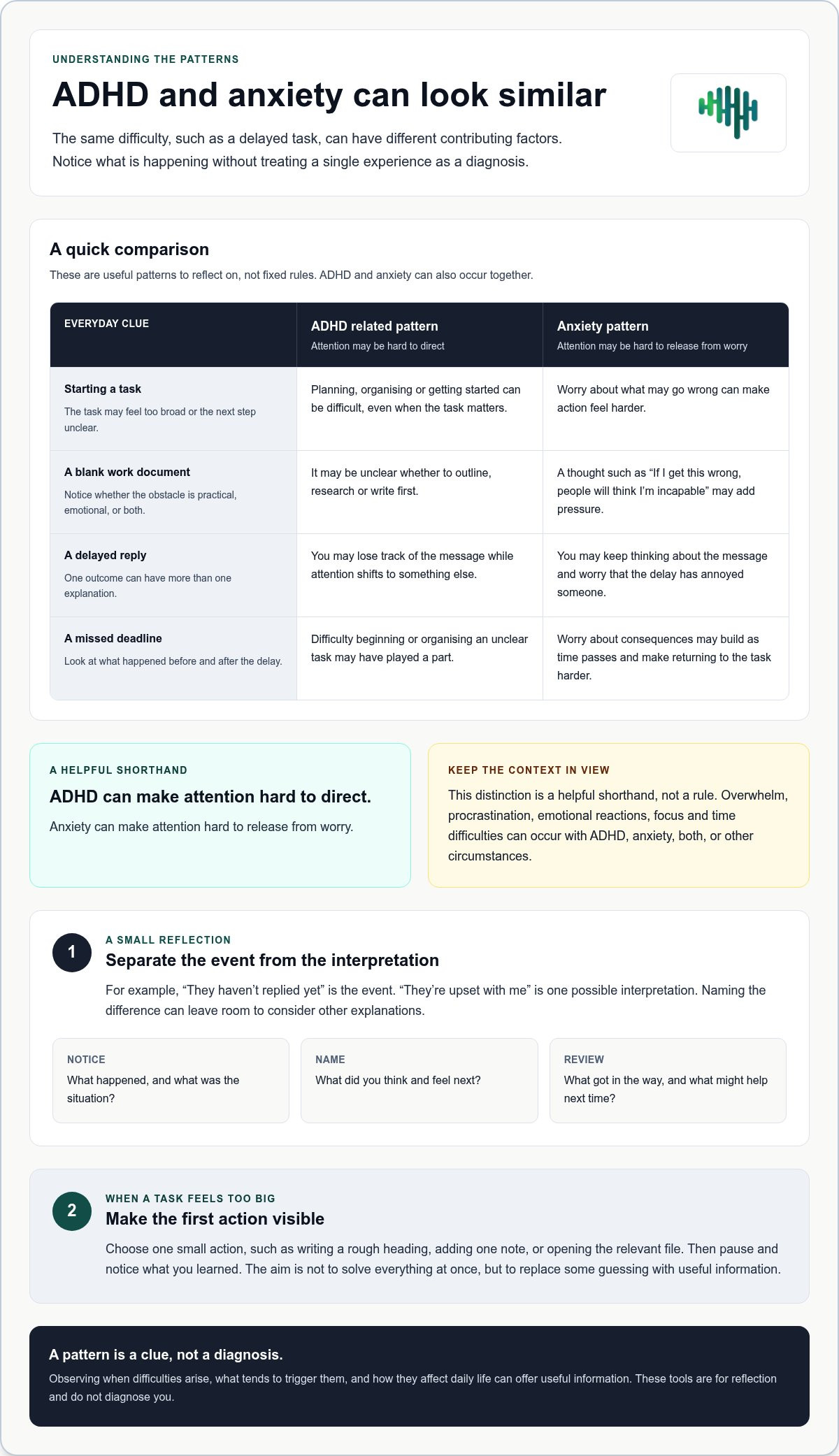
A useful distinction: ADHD can make attention hard to direct; anxiety can make attention hard to release from worry. This is a helpful shorthand, not a rule. A missed deadline might follow difficulty beginning an unclear task, worry about making a mistake, or a mix of both. The same outward result can have different contributing factors.
What can ADHD and anxiety look like in everyday adult life?
You open an email, try to find the perfect words, and decide to return to it later. You may then lose track of the message while dealing with something else, or keep thinking about it and worrying that the delay has annoyed someone. Attention, planning and worry can compound, but that sequence will not explain every delayed reply.
Emotional reactivity, such as feeling suddenly upset by a small setback, can also make it harder to return to a task. So can overwhelm when several demands compete for your attention. Neither feeling, on its own, proves a diagnosis. Notice the specific situation, what you thought and felt, and what happened next.
Why can the symptoms feel difficult to untangle?
Poor concentration, restlessness and disrupted sleep can show up in more than one context. A busy period, a demanding responsibility or a change in routine may affect focus and rest, while ongoing attention or worry patterns may also play a part. The overlap does not necessarily have one simple explanation.
Unfinished tasks can add another layer: a missed deadline may lead to worry about the consequences, which can make the next task even harder to approach. Instead of deciding immediately what the pattern means, observe when it appears, what tends to trigger it and how it affects daily life. If you want to explore the emotional side further, Collins Psychology shares practical CBT strategies for emotional regulation.
Our private services are not appropriate for acute incidents or urgent support. If you are in crisis, contact Samaritans 116 123, your GP, or dial 112 or 999.
How the ADHD and anxiety cycle can affect focus, emotions, and daily tasks
A task can feel difficult before you even begin. If the next step is unclear, getting started may be delayed; as time passes, worry about the consequences can grow, making avoidance feel like short term relief. The task remains, though, and the added pressure can make returning to it harder.
The ADHD and anxiety cycle is a possible pattern where difficulty starting or organising a task feeds worry, and worry then makes action feel harder. It is an explanatory model, not a universal sequence or a diagnosis. Some people recognise parts of it, while others experience attention difficulties and worry in different ways or at different times.
How can task initiation difficulties and worry reinforce each other?
Imagine opening a work document and seeing a blank page. The practical obstacle might be that the task feels too broad: you do not know whether to outline, research or write first. Separately, an anxious prediction might be, “If I get this wrong, people will think I’m incapable.” The first calls for a clearer starting point; the second is a thought to notice and examine, rather than treat as a fact.
Make the first action small enough to see: write a rough heading, add one note, or open the relevant file and place it beside the document. Then pause and notice what you learned. Perhaps the task is clearer, or perhaps you need more information. One small step will not solve every difficulty, but it can replace some guessing with useful information.
When a plan falls apart, self criticism can add distress. “I should have done this already” may quickly become “I always let people down.” A missed plan is information about what got in the way, not proof of personal failure. Ask yourself, “Was the first step unclear? Did I misjudge the time? Was I worried about the result?” Specific questions can help you identify what might make another attempt more manageable.
How can emotional reactivity and rejection sensitivity add pressure?
Feedback or an unanswered message may prompt intense worry for some adults. A short reply can be interpreted as annoyance, or constructive feedback can feel like evidence of failure, especially after a stressful day. These reactions are real and worth responding to with care, but rejection sensitivity is not a formal diagnosis or a universal feature of ADHD.
Before replying or withdrawing, name the event and the interpretation separately: “They haven’t replied yet” is different from “They’re upset with me.” That pause can support emotional regulation and leave room for other explanations. For practical ideas on working with strong feelings, explore these CBT strategies for emotional regulation.
For structured, 100% online, self paced CBT tools for everyday ADHD challenges, explore the Adult ADHD Foundations Program™. It is designed to offer practical strategies for daily functioning. It is not a substitute for therapy or medical diagnosis and treatment.
How to distinguish ADHD related difficulties from anxiety patterns
With ADHD and anxiety in adults, similar difficulties can have different contexts, and both patterns may occur together. A comparison can help you notice what is happening, but it cannot diagnose you. Look for recurring details across situations rather than relying on one difficult day.
Pattern to notice
Context: Does organising or starting tasks feel difficult across different parts of life, or mainly in situations linked to a particular concern?
Timing: Has the difficulty been present over a long period, or does it seem to rise during a stressful period or after a specific change?
Triggers: Does the task itself feel hard to begin or sequence, or does worry about a possible outcome seem to pull you away from it?
Effect on daily life: Are unfinished tasks, missed steps or time management difficulties recurring? Or does avoidance tend to centre on situations that feel threatening or uncertain? Either pattern can affect daily functioning.
These are prompts for reflection, not a scoring system. Longstanding patterns and current stressors may both matter. For instance, a change at work could increase worry while also making planning and prioritising more demanding. Record a few real examples, including what was happening, what you noticed, what you did next and how it affected your day.
What patterns might suggest an ADHD related difficulty?
Notice whether organising, starting, sequencing or completing tasks is repeatedly difficult, including for routine activities that do not seem especially worrying. Perhaps you begin several jobs but lose track of the steps, or underestimate how long a familiar task will take. These examples can help describe what is happening, but this article cannot determine whether you have ADHD.
Write down situations and their impact rather than labelling yourself. A note such as “I opened the form, couldn’t work out which section came first, and left it unfinished” gives more useful detail than “I’m hopeless at paperwork”. Include what helped, if anything, such as a reminder, clearer instructions or breaking the task into parts.
What patterns might point to anxiety playing a role?
Notice whether worry, predictions about what might go wrong or avoidance appear around particular concerns. You might find that a task becomes harder when you expect criticism, while other routine tasks feel more manageable. Or the challenge may persist across activities, even when no specific worry is obvious. These observations can guide reflection, but they are not proof of a diagnosis.
Brief notes on when worry appears and how it changes your choices can make the pattern easier to describe. Only an appropriate assessment can establish a diagnosis, and overlapping experiences may need careful consideration. For a closer look at support options, read about a structured CBT approach to ADHD and anxiety in adults. If you are looking for practical, self paced online tools for daily functioning, explore the Adult ADHD Foundations Program™.
Practical CBT strategies for ADHD task initiation, time blindness, and overwhelm
When a task feels too big to begin, a clear first action can make it easier to approach. This brief CBT exercise helps you notice what is getting in the way and choose a manageable next move. It is a flexible tool, not a test you need to complete perfectly.
Name the task.
Be specific, such as “reply to Sam’s message” rather than “catch up on messages”.
Choose a first action.
Pick something physical and small, like opening the message and reading it once.
Set a visible cue.
Leave the message open, write a note beside your keyboard, or add a reminder to your calendar.
Review.
Notice what helped, what still feels difficult, and what the next small action could be.
A small first step for task paralysis and procrastination
Suppose the laundry has been sitting in a basket for days. “Do the laundry” may feel like a chain of jobs, so choose one action that is small enough to begin, such as putting a load into the machine. If worry comes up, try saying, “I’m worried I won’t finish, but I can start with this one part.”
You do not need to feel completely confident first. Starting may show you that the next action is easy, or that you need to find detergent or clear space. If you stop before the whole task is done, that is useful information, not proof of failure. Review the obstacle and adjust the next action to fit what is actually possible.
A quick CBT map
Trigger: Laundry is still in the basket.
Thought: “This will take all evening.”
Feeling: Tense and overwhelmed.
Action: Put it off and look at your phone.
Next small step: Put one load into the machine, then review how you feel.
A flexible plan for time blindness and overwhelm
Time blindness can make it hard to sense how long a task has taken or how soon you need to switch activities. Externalise time with a calendar, timer, written sequence or visible reminder. Pair a task with cues for when to start, what to do next and how to recognise that you are finished, without expecting every day to follow the same routine.
Allow a realistic transition buffer when moving from one activity to another. The amount can vary with the task, your energy and what else is happening, so treat it as something to adjust rather than a rigid rule. If a reminder goes off and you feel stressed, pause, notice what is unfinished, then choose one manageable next action. For more ideas, explore CBT for time management and organisation.
Our private services are not appropriate for acute incidents or urgent support. If you are in crisis, contact Samaritans 116 123, your GP, or dial 112 or 999.
Explore the Adult ADHD Foundations Program™
A practical reset when you feel stuck
Notice
Name the task and what is making it feel difficult.
Separate
Write down the situation, your thought and your feeling.
Shrink
Choose one visible first action, not the whole project.
Support
Add a reminder, timer or written cue to help you return to the task.
Review
Notice what helped, then adjust the next step to fit your day.
How online CBT support can help adults with ADHD and anxiety
Structured CBT learning can offer practical ways to work with thoughts, feelings and everyday behaviour. CBT is an evidence based therapeutic approach that can be combined with medication; an online programme is not a stand alone medical treatment. Individual needs and experiences vary (Hofmann et al., 2012; Solanto, 2011).
What can structured online CBT offer in daily life?
Collins Psychology supports adults with ADHD who feel overwhelmed and stuck to build practical systems for daily life. The Adult ADHD Foundations Program™ offers structured CBT learning, with exercises to practise setting manageable goals, noticing emotional responses and planning practical next steps. CBT approaches for adult ADHD include strategies aimed at executive functioning and daily challenges (Solanto, 2011).
The programme is 100% online and self paced, so you can work through the learning around everyday life. It is designed for adults with or without a formal ADHD diagnosis, and its structured, workbook supported modules focus on practical skills. The programme duration is 8 - 16 sessions (or 8 - 16 hours).
Optional bonus modules cover sleep, fitness and focus, parenting challenges, and late diagnosis support. These topics can help you consider how routines and responsibilities affect your daily life, alongside areas such as time management and emotional regulation. The learning offers practical tools for daily functioning, but does not provide a diagnosis or replace medical diagnosis, treatment or therapy.
Explore the Adult ADHD Foundations Program™ to see how structured learning could fit around your life. The programme is 100% online and self paced. Choose one area to work on first, then practise and adapt the strategies as you go.
How can you choose a manageable next step?
Choose one everyday difficulty to focus on first, such as remembering an appointment or getting started on a household task. Try one strategy, then notice what supported you and what got in the way. Adjust the approach to suit your circumstances rather than expecting yourself to change every routine at once.
Small experiments can help you learn whether a written prompt, calendar reminder or clearer first step suits that particular task. If you have a late ADHD diagnosis, or are still exploring what ADHD means for you, you can start with an everyday challenge rather than trying to address everything at once. The aim is a practical system that supports daily life, not a perfect routine.
Choose one next step that feels doable
Change does not have to begin with a complete plan. Choose one everyday moment where ADHD and anxiety in adults make things feel harder, then decide what small support could help you respond differently. A reminder, a clearer first step or a pause before acting can be a useful experiment. Notice what works for you and adjust without expecting every day to go smoothly.
If you want a structured way to practise, the Adult ADHD Foundations Program™ is psychologist developed and evidence based. It is 100% online and self paced, with practical learning designed to fit around real life. The programme offers tools for daily functioning and is not a substitute for therapy.
Explore the Adult ADHD Foundations Program™
You do not need to have everything figured out before you begin. A manageable step, repeated and adapted to your needs, can help you move towards daily systems that feel more supportive. Keep going at your own pace and build systems that work WITH your ADHD brain
References
Hofmann, S. G., Asnaani, A., Vonk, I. J. J., Sawyer, A. T., & Fang, A. (2012). The efficacy of cognitive behavioral therapy: A review of meta analyses. Cognitive Therapy and Research, 36(5), 427 to 440. https://doi.org/10.1007/s10608-012-9476-1
Solanto, M. V. (2011). Cognitive behavioral therapy for adult ADHD: Targeting executive dysfunction. Guilford Press.
Frequently Asked Questions
Can ADHD cause anxiety in adults?
ADHD related challenges and anxiety can interact, but the relationship differs from person to person. Repeated difficulty arriving on time, for example, may create worry about disappointing a colleague, while worry about a meeting may make preparation harder. This does not show that ADHD caused anxiety or confirm either condition. If a pattern affects work, relationships or rest, note when it happens and discuss your concerns in an appropriate assessment.
How can I tell whether I have ADHD or anxiety?
Difficulty concentrating on its own cannot tell you whether you have ADHD or anxiety. Notice the situations where it happens, how long the pattern has been present, what tends to trigger it and how it affects daily life. A brief note such as “I lost track during routine paperwork after a poor night’s sleep” can be more useful than a label. Discuss your examples with an appropriately qualified clinician; a comparison chart cannot diagnose you.
Can online CBT help adults with ADHD and anxiety?
Online CBT can provide practical ways to work with thoughts, feelings and everyday behaviour, though what feels useful varies between people. Collins Psychology programmes are 100% online and self paced, with learning focused on practical daily functioning. You might practise making a task more manageable or plan a reminder around a regular responsibility. The programmes do not provide a diagnosis and are not a substitute for therapy or medical diagnosis and treatment.
What can I do when anxiety makes it hard to start a task?
Name the task, choose one visible first action, then notice the worry without assuming it is a fact. For example, before making a phone call, you could write down the first sentence you want to say and place it beside your phone. Treat this as a flexible experiment, not a routine you must get perfect. Our private services are not appropriate for acute incidents or urgent support. If you are in crisis, contact Samaritans 116 123, your GP, or dial 112 or 999.
Can ADHD and anxiety affect time management?
Yes, difficulties estimating time, organising steps or getting started can overlap with worry and avoidance. Try putting appointments and transition reminders somewhere visible, then break a larger job into actions such as gathering materials, starting and checking what remains. These experiments may help you see what supports your routine, but they do not establish a condition. For more ideas, explore this guide to CBT for time management and organisation.
Is it possible to use an ADHD programme without a formal diagnosis?
Yes. Collins Psychology programmes are intended for adults with or without a formal ADHD diagnosis. The Adult ADHD Foundations Program™ offers structured, 100% online, self paced learning to practise practical strategies for daily life, such as planning around a recurring responsibility. Taking part does not determine whether you have ADHD, provide a diagnosis or replace medical diagnosis or treatment. You can use the learning to explore helpful approaches without treating it as a diagnostic test.
Medical and Mental Health Disclaimer
The information provided on this page, in the Adult ADHD Foundations Program™, individual Collins Psychology programs and the Adult ADHD Reflection Quiz is for general educational and informational purposes only and is not a substitute for individual medical, psychological or psychiatric assessment, diagnosis or treatment. These resources do not diagnose ADHD or any other condition and are not psychotherapy, counselling, crisis support or personalised treatment. Although the material is psychologist-developed and informed by psychological research and evidence-based approaches, individual outcomes will vary and no specific result can be guaranteed. If you are experiencing severe or worsening psychological symptoms, significant impairment, thoughts of harming yourself or another person, or concerns about your safety, seek support from an appropriately qualified health professional or contact the emergency or crisis service appropriate to your location.