

What if the stress you feel isn’t a sign that you’re failing, but a signal that your daily systems aren’t working for your ADHD brain? Task paralysis, time blindness and difficulty shifting focus can make ordinary responsibilities feel relentless. This article explores how to manage stress with adult ADHD and offers practical ways to make daily demands feel more manageable.
ADHD related challenges and stress can reinforce one another. You may delay a task because it feels overwhelming, then feel more pressure as a deadline gets closer. That cycle can leave you exhausted or worried about burnout, particularly if a late diagnosis has you rethinking long standing coping strategies.
Here, you’ll find practical CBT approaches for getting started, managing strong emotions and making routines more workable around everyday responsibilities. The aim isn’t to do everything perfectly. It’s to find realistic supports that help you feel less stuck and more able to follow through.
Key Takeaways
• See how ADHD related challenges can add pressure, without treating overwhelm or task paralysis as a personal failing.
• Learn a simple pause, name, plan and begin approach to make an overwhelming task feel more manageable.
• Explore flexible routines that support time management and reduce the risk of running on empty.
• Find out how to manage stress with adult ADHD using practical strategies for emotional regulation, task initiation and daily demands.
• Discover how online, self paced CBT learning can help you practise practical skills around real life.
Why Stress Can Feel Harder to Manage with Adult ADHD
If everyday demands sometimes leave you feeling overwhelmed, that doesn’t mean you’re lazy or incapable. People with ADHD experience stress in different ways, and the same task may feel manageable one day and difficult to start the next. Stress is the body and mind’s response to demands, especially when those demands feel greater than the time, energy or support available. ADHD challenges with attention, organisation and task initiation can add pressure to ordinary responsibilities. The overview of attention deficit hyperactivity disorder describes how it can affect daily functioning, though each person’s experience is individual.
How to manage stress with adult ADHD begins, in part, with recognising what is creating pressure rather than blaming yourself for feeling it. A missed appointment may mean extra calls to rearrange it. An email that needs a careful reply can sit unopened while other demands take your attention. Time blindness can make a deadline feel distant until it suddenly feels urgent. Each unfinished task can occupy attention, even when you’re trying to focus on something else.
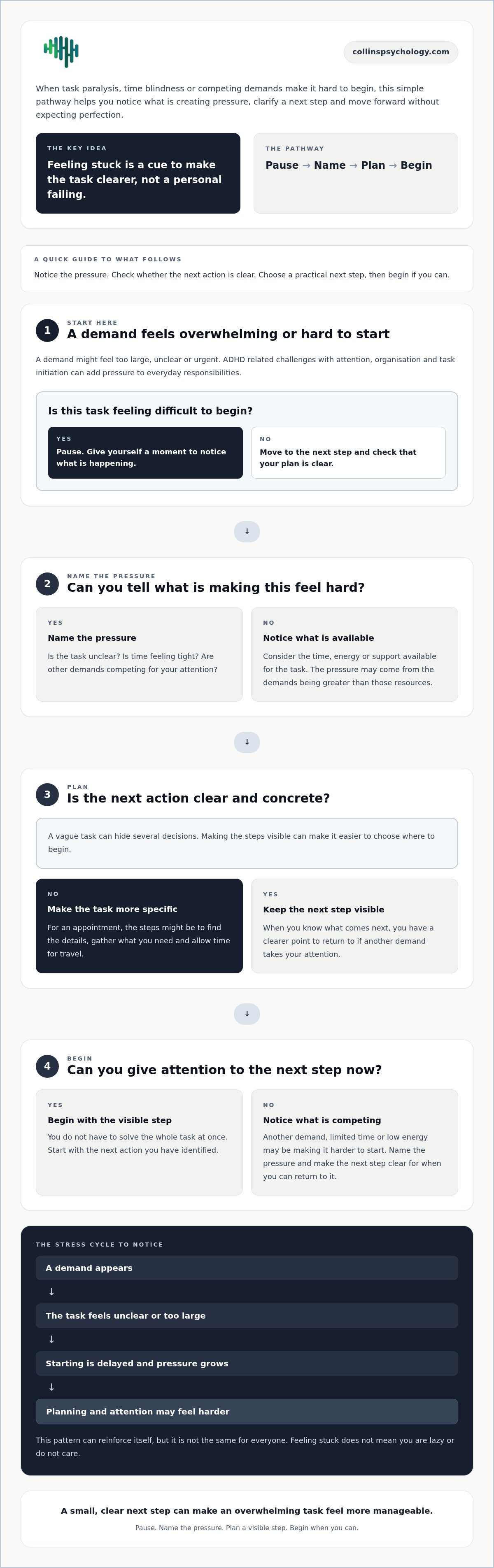
A demand feels overwhelming, starting becomes difficult, delay adds pressure, and that pressure makes the next step feel harder.
Difficulty starting or organising tasks can relate to executive functioning, the mental skills used to plan, prioritise and follow through. These skills aren’t a measure of character or effort. If you want to explore how prolonged pressure can affect daily life, Collins Psychology’s guide to chronic stress in adults with ADHD offers further context.
How ADHD challenges can add to everyday stress
Imagine you need to send an important email. You may delay it because you’re unsure how to begin, lose track of time, then remember it when another deadline is close. The growing pressure can make the email feel even harder to face. If a reminder or follow up feels critical, emotional reactivity may intensify an already demanding moment. This doesn’t happen to everyone, but it can be part of the experience for some adults with ADHD.
When ongoing pressure begins to feel like burnout
With pressure that continues, you might notice exhaustion, irritability or less motivation for tasks that once felt manageable. These experiences can be signs that your current demands are taking a toll, but they don’t establish a diagnosis. Burnout and depression aren’t interchangeable terms, and persistent changes in mood, energy or daily functioning are worth discussing with a health professional.
Our private services are not appropriate for acute incidents or urgent support. If you are in crisis, contact Samaritans 116 123, your GP, or dial 112 or 999.
The ADHD Stress Cycle: From Overwhelm to Task Paralysis
Stress can build through a series of small moments, not just one major event. A request arrives while you’re concentrating on something else. You try to hold it in mind, but another demand takes your attention, and soon you’re unsure what to do first. This pattern isn’t the same for everyone, and stress does not cause ADHD. Rather, ADHD related challenges and external demands can interact in ways that make some situations feel harder to manage.
Task paralysis is when you feel unable to begin or continue a task, even though you know it needs attention; it isn’t laziness or a lack of caring. Executive functioning means the mental skills involved in organising, prioritising, remembering steps and getting started. When these skills are under strain, deciding where to begin can take considerable effort. Feeling stuck may then bring frustration or worry, which can make it harder to choose a next step.
A useful way to picture the stress cycle is as a sequence: a demand appears, the task feels unclear or too large, starting gets delayed, and the remaining time or unfinished work adds pressure. That added pressure may make attention and planning feel more difficult, so the task can seem even harder to approach. The ADHD Burnout Cycle is one way this reinforcing pattern is described, although people’s experiences vary and a cycle is not a diagnosis.
Why task initiation and time blindness can raise pressure
A vague task such as “get ready for the appointment” can hide several decisions: find the details, gather what you need, allow for travel and finish another task first. If those steps aren’t visible, choosing a starting point may feel difficult. Time blindness can also make the preparation seem quicker than it is, leaving less time than expected. This isn’t a personal failing; it’s a cue to make the task and its timing more concrete.
For example, you might be answering work messages while preparing for an appointment. You intend to check the appointment time in a moment, but the messages keep arriving. When you look up, there’s less time to gather what you need and leave. The pressure comes from several demands competing for attention, not from a lack of concern about the appointment.
How emotional reactivity can amplify an already stressful moment
Frustration or worry can rise quickly when plans change or a deadline feels close. In that heightened moment, it may be harder to pause, consider what is happening and choose how to respond. Some adults also experience strong sensitivity to perceived criticism or rejection, but this isn’t universal and shouldn’t be treated as a diagnosis. A practical guide to regulating your stress response explores ways to notice and manage these moments.
Understanding the pattern gives you a place to intervene: clarify the next action, make time visible or pause before responding. If you’d like structured CBT tools for everyday ADHD challenges, explore online CBT support for adults with ADHD.
Practical CBT Strategies for Stress with Adult ADHD
When a task feels too big to start, trying to force yourself through the whole list can add pressure. A short CBT based process can help you pause, identify what is happening, choose one workable action and begin. It is not about making every feeling disappear. It is a way to respond to the moment with a little more clarity.
Use a small first step to make task initiation easier
Try this four step sequence when you notice task paralysis or an overwhelming to do list:
Pause.
Stop for a moment before adding another demand or criticising yourself.
Name.
Identify what is going on: “I feel overwhelmed because I can’t see where to start.”
Plan.
Choose one action that is clear and small enough to begin.
Begin.
Do that action, then decide whether to continue, take a break or adjust the plan.
For example, “sort out the bills” may feel like one large, unclear job. Change it into a first action: “Open the latest bill and find the due date.” A few minutes of progress is still progress. If self criticism shows up, try replacing “I should be able to do this” with “This feels difficult, so I’ll make the first step clearer.” A time management and organisation guide can also help you think about how to make tasks more visible and manageable.
A four step reset for a stuck moment
Pause
Put down the growing to do list.
Name
“I’m overwhelmed by the paperwork.”
Plan
Find the first form.
Begin
Open it and read the first question.
Regulate the moment before choosing what to do next
If frustration or worry is running high, take a brief pause before replying to a message or switching tasks. Notice the feeling and name it without judging yourself: “I’m tense and worried about getting this wrong.” You might take a few comfortable, slower breaths or feel your feet on the floor. This isn’t a cure or a demand to feel calm; it creates a moment to choose your next response.
Then return to the plan and ask, “What is the next action I can see?” If a request feels urgent, you could write it down first, check what you were already doing, and decide which task needs attention now. A short pause can help you respond more deliberately, even if the feeling is still present. Collins Psychology’s adult ADHD emotional regulation strategies offer further practical ideas for managing strong feelings.
How to manage stress with adult ADHD can involve practising this sequence until it becomes easier to reach for in everyday moments. Collins Psychology supports adults who feel overwhelmed and stuck with practical systems for daily life. Explore the Adult ADHD Foundations Program™ for structured CBT learning that you can work through at your own pace.
Build Sustainable Routines to Reduce Overwhelm and Burnout
A helpful routine isn’t a perfect timetable. It’s a flexible system that makes everyday tasks easier to remember, start and return to when the day changes. Rather than planning for your most focused, energetic day, build around what you can reasonably manage on an ordinary one. That can mean choosing a simple meal, leaving space between commitments or setting aside time to rest.
Realistic expectations matter. If every available minute is filled with tasks, an interruption can make the whole plan feel lost. Planned recovery time, even a quiet pause between work and home responsibilities, can help you avoid treating rest as something you have to earn only after everything is finished.
| Rigid routine | Small, adjustable routine |
|---|---|
| Plan every evening task in exact detail. | Choose one priority and one easier backup. |
| Assume a disrupted day means the plan has failed. | Restart with the next useful action. |
| Expect the same energy and focus every day. | Adjust the plan to the time and energy available. |
Make routines easier to remember and restart
Visible reminders, a calendar alert or a note by the door may help you remember a routine, but no one tool suits everyone. Try linking a new action to something that already happens. For example, when finishing work, put your bag in its usual place, check what is needed for dinner and choose the simplest meal that will work tonight.
If parenting means the evening routine changes often, keep the reminder focused on one anchor, such as starting dinner, rather than expecting every step to happen at the same time. If you’ve received a late diagnosis, you may be building routines after years of relying on last minute effort. Give yourself room to test what helps. A disrupted day doesn’t erase the routine; restarting with the next small action is part of it.
Set limits that protect attention and recovery
Not every demand needs an immediate response. You might sort tasks into what must happen today, what can wait and what could be simplified. If a request competes with an essential task, a clear limit can reduce overload: “I can’t take that on today, but I can look at it tomorrow.” This gives the other person useful information without requiring a long explanation.
Protecting time for movement can also support a realistic routine. If a full workout feels out of reach, a short walk or stretch may be a more workable option, especially on a low focus day. The aim is consistency that can bend, not a strict fitness target that adds pressure. If ongoing demands are leaving little room to recover, practical guidance on chronic stress and ADHD can help you consider the pattern.
How to manage stress with adult ADHD includes making routines fit changing energy, attention and responsibilities. Collins Psychology supports adults who feel overwhelmed and stuck to build practical systems for daily life.
ACCESS ADULT ADHD PROGRAM
How Online CBT Support Can Help You Practise Stress Strategies
Understanding a strategy is one thing. Remembering to use it when you’re tired, distracted or facing a full day can be harder. Structured CBT learning gives you a way to practise skills for everyday situations, reflect on what gets in the way and adapt your approach. You might work on noticing an early sign of overwhelm, making a task clearer or choosing a manageable next step.
What structured online CBT learning offers
CBT looks at how thoughts, feelings and actions can influence one another. In practical learning, that might mean noticing a thought such as “I’ll never get through this list”, checking what the list actually requires and selecting one realistic action. Repeating this kind of practice can help you build strategies for emotional regulation and daily functioning, including planning, time management and following through. The aim is to develop useful tools, not to expect yourself to get everything right.
Collins Psychology’s Adult ADHD Foundations Program™ is 100% online and self paced, so adults can access the programme worldwide and work through the learning at their own pace. It takes 8 to 16 sessions (or 8 to 16 hours). Optional bonus modules cover sleep, fitness and focus, parenting, and late diagnosis, offering ways to explore areas that may matter in your own life.
This programme offers practical CBT learning for everyday use. It is not a substitute for therapy, diagnosis or treatment. If you already have support, the skills can sit alongside it as learning to practise between everyday demands, rather than as a replacement for individual care.
Choose a manageable next step
Start by naming one recurring stress point. It could be opening work messages after a busy morning, keeping track of appointments or finding a way to move your body when your energy is low. Pick something specific enough to recognise when it happens. You don’t need to solve every challenge at once.
Then consider what you would like to practise in that situation. Perhaps you want to pause before responding, use a reminder, or break a task into a first action. If a strategy doesn’t fit your routine, that’s useful information: you can adjust it rather than conclude that you’ve failed. Small experiments make it easier to learn what works in real life, including on days when focus or energy changes.
Collins Psychology supports adults with ADHD who feel overwhelmed and stuck to build practical systems that improve daily life. The Adult ADHD Foundations Program™ provides structured, self paced CBT learning to help you explore strategies for your own day to day demands. You can build systems that work WITH your ADHD brain.
Take One Practical Step Towards Calmer Days
Progress can start with noticing one recurring pressure point and asking what would make it easier to handle next time. Perhaps you could try a reminder, make a transition more visible or plan a pause after a demanding part of the day. Treat it as an experiment, not a test of whether you can follow a perfect routine. Keep what helps and adjust what doesn’t.
If you’d like structured support to practise practical strategies, the Adult ADHD Foundations Program™ is a psychologist developed programme led by Elaine Collins. Its 100% online, self paced learning is for adults with or without a formal ADHD diagnosis, and is designed to fit around real life. You can take a look and decide whether it feels like a useful next step for you.
Learning how to manage stress with adult ADHD isn’t about changing who you are. It’s about making daily demands more workable, one adjustment at a time. You can build systems that work WITH your ADHD brain
Frequently Asked Questions
Can adult ADHD make stress feel harder to manage?
It can, although adults with ADHD don’t all experience stress in the same way. Holding several demands in mind, switching between tasks or recovering after an interruption may take extra effort, leaving less capacity for unexpected problems. For example, a changed meeting time could disrupt plans for the rest of the morning. Noticing which situations raise your pressure can help you decide what adjustment might make them easier.
What are common signs of stress or burnout in adults with ADHD?
Possible signs include feeling unusually drained, becoming more irritable, losing interest in tasks or finding everyday decisions harder than usual. You might also notice that you’re avoiding messages or withdrawing from activities you normally value. These experiences can have different causes and don’t confirm burnout or another condition. If changes persist or interfere with daily life, consider discussing them with a health professional.
How can I calm down when I feel overwhelmed by ADHD tasks?
How to manage stress with adult ADHD can begin with reducing what your attention has to handle right now. Close unrelated tabs, silence a non urgent notification if you can, and write the immediate demand on paper. Then decide whether it needs action now or can wait. If you’re too activated to choose, step briefly into a quieter space or ask for a moment before replying.
Can breaking tasks into smaller steps help with ADHD task paralysis?
Yes, a clearly defined step can make it easier to see how to begin. If “do the laundry” feels like too much, choose a visible action such as putting clothes into the machine. After that, decide on the next step rather than needing to plan the whole job at once. A written checklist can also show what you’ve completed, which is useful if you get interrupted.
How can I manage time blindness when I am already stressed?
Use an external cue rather than relying on a stressed mind to keep checking the time. Set an alarm for when you need to stop one activity and prepare for the next, then add a separate reminder for leaving. For a meeting, count backwards from the start time to include travel or setup. If your estimate was off, note the difference to inform future plans, not to criticise yourself.
Can online CBT help adults with ADHD manage stress?
Online CBT can offer structured learning and opportunities to practise practical skills, such as planning, noticing unhelpful thought patterns and choosing a manageable action. CBT approaches for adult ADHD include strategies aimed at everyday challenges, though what is useful will vary from person to person (Ramsay & Rostain, 2015). Online learning is not the same as individual therapy, and a programme is not a substitute for diagnosis or treatment.
Medical and Mental Health Disclaimer
The information provided on this page, in the Adult ADHD Foundations Program™, individual Collins Psychology programs and the Adult ADHD Reflection Quiz is for general educational and informational purposes only and is not a substitute for individual medical, psychological or psychiatric assessment, diagnosis or treatment. These resources do not diagnose ADHD or any other condition and are not psychotherapy, counselling, crisis support or personalised treatment. Although the material is psychologist-developed and informed by psychological research and evidence-based approaches, individual outcomes will vary and no specific result can be guaranteed. If you are experiencing severe or worsening psychological symptoms, significant impairment, thoughts of harming yourself or another person, or concerns about your safety, seek support from an appropriately qualified health professional or contact the emergency or crisis service appropriate to your location.