.png)

If you are an adult with ADHD, you likely know the frustration of procrastination all too well. It is more than just putting things off; it is a cycle of delay, overwhelm, and guilt that can impact your work, relationships, and self-esteem. This article explains the neurological reasons behind procrastination problems for adults with ADHD, exploring the roles of brain chemistry and executive functions. More importantly, it provides evidence-based strategies, rooted in Cognitive Behavioural Therapy (CBT), to help you break the cycle and regain control.
The ADHD Brain & The 'Wall of Awful': Why Procrastination Happens
Procrastination in adults with ADHD is not a moral failing or a sign of laziness. It is a genuine challenge rooted in the unique neurobiology of the ADHD brain. At its core is a concept known as Executive Dysfunction, which refers to difficulties with the brain’s management systems that control planning, organising, and executing tasks (Barkley, 2012). This is often compounded by emotional dysregulation, where intense feelings of overwhelm, anxiety, or boredom create a powerful urge to avoid a task. This experience is sometimes described as hitting a 'Wall of Awful', a metaphorical barrier of negative emotions that makes starting feel impossible.
The Role of Dopamine
Dopamine is a key neurotransmitter in the brain associated with motivation, reward, and pleasure. For a neurotypical brain, the anticipation of completing a task and receiving a reward is enough to generate sufficient dopamine to get started. In the ADHD brain, however, dopamine regulation is different (Volkow et al., 2009). There are often lower baseline levels of dopamine, which means that mundane, low-interest, or long-term tasks do not provide enough of a neurochemical 'kick' to seem worth starting. This is why many people with ADHD are drawn to novelty and high-stakes situations, like a last-minute deadline, which finally provide the dopamine surge needed for action.
Key Executive Function Challenges
Several specific executive function deficits contribute directly to procrastination problems for adults with ADHD.
Task Initiation
This is the ability to begin a task without procrastinating. For the ADHD brain, the hurdle to 'just get started' can feel immense due to the dopamine issues mentioned above (Ramsay & Rostain, 2015).
Time Blindness
Many adults with ADHD have a distorted perception of time. It can be difficult to accurately estimate how long a task will take or to feel the passage of time, leading to chronic miscalculation and delay (Barkley, 2012).
Working Memory
This is the ability to hold and manipulate information in your mind to complete a task. Weaknesses in working memory can make it easy to forget what you were about to do, lose track of steps in a process, or become easily sidetracked.
Emotional Barriers: The 'Wall of Awful'
Procrastination is often an attempt to avoid uncomfortable feelings associated with a task. This 'Wall of Awful' can be built from several emotional bricks:
Fear
of failure or not performing perfectly.
Anxiety
that the task will be too difficult, long, or boring.
Overwhelm
from not knowing where or how to begin.
Guilt and shame
from past experiences with procrastination, creating a negative feedback loop.
Foundational Strategies: Setting Up Your Environment for Success
Before tackling in-the-moment procrastination, it is crucial to set up your physical and digital environments to support your brain. The goal is to reduce the friction between you and the task. By creating external structures, you can compensate for internal executive function weaknesses, making it easier to implement other strategies.
Externalise Your Brain
Your working memory is already taxed, so do not rely on it to remember tasks, appointments, or ideas.
Use visual aids
A large whiteboard or sticky notes on a wall can keep your to-do list visible and top-of-mind.
Set multiple alarms and reminders
Use your phone or smart watch for everything from taking a break to starting a specific task.
Keep tools accessible
Store items where you will use them. If you want to go for a run in the morning, lay out your running clothes the night before.
Engineer Your Focus Zones
Your environment sends powerful cues to your brain. Designate specific areas for specific activities to help your brain switch into the right mode.
Create dedicated spaces
If possible, have a spot just for work, another for relaxing, and another for hobbies.
Minimise auditory and visual distractions
Use noise-cancelling headphones or listen to white noise. Face a wall to avoid being distracted by movement. Consider 'body doubling', where you work quietly alongside another person, either in person or virtually.
Block digital distractions
Use website blockers and app-limiting software during focus periods.
Manage Your Energy, Not Just Your Time
Executive functions are highly dependent on your physical and mental energy levels.
Identify your peak energy times
Are you sharpest in the morning or late at night? Schedule your most demanding tasks for these periods.
Prioritise sleep
Poor sleep significantly worsens ADHD symptoms, especially executive functions (Wajszilber et al., 2018).
Reduce decision fatigue
Simplify choices where possible. For example, plan your meals for the week or have a standard 'work uniform' to reduce daily mental load.
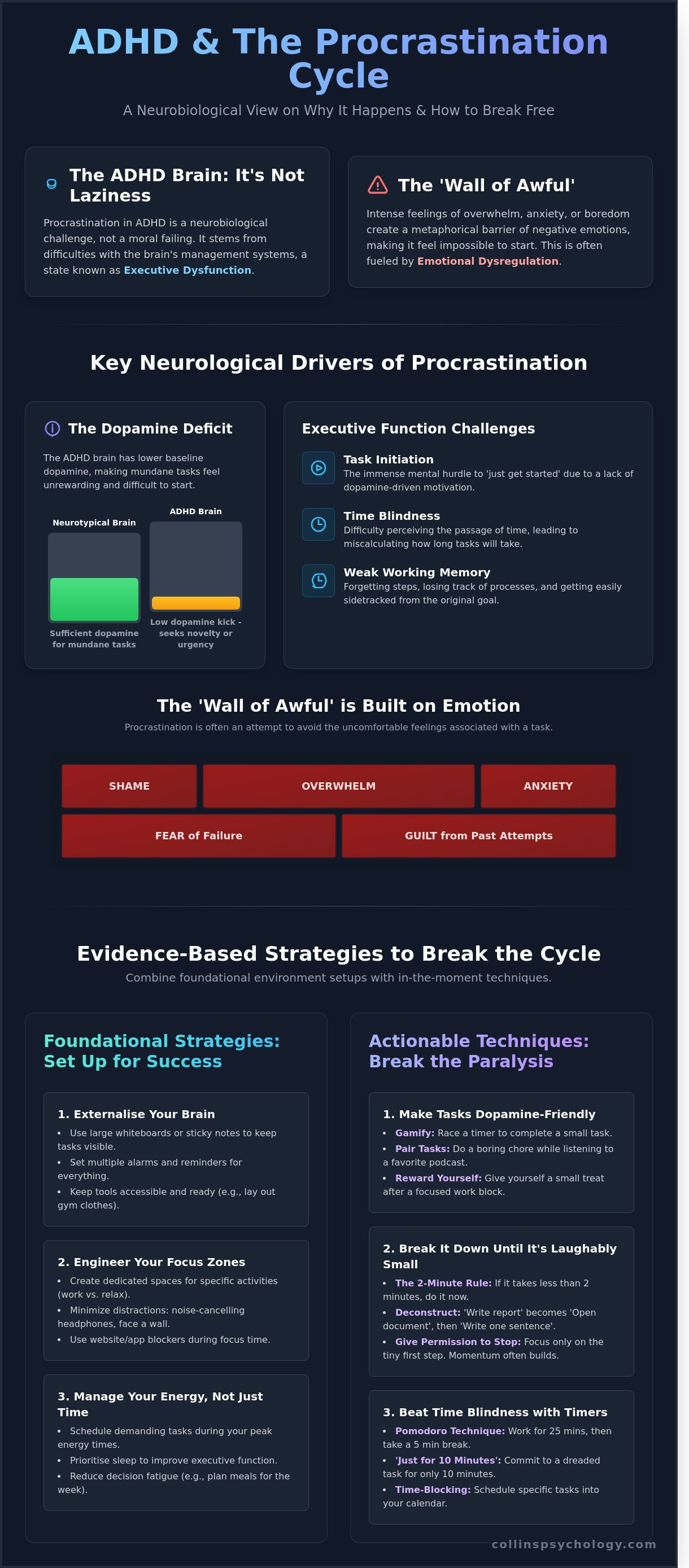
Actionable Techniques to Break Through Procrastination Paralysis
These are in-the-moment strategies to use when you feel stuck. Think of them as experiments, not rigid rules. The aim is to trick your brain into action by making tasks seem less intimidating.
Make Tasks Dopamine-Friendly
Since the ADHD brain is motivated by interest and reward, you need to add that element to boring tasks.
Gamify your work
Set a timer and race against yourself. Turn a cleaning task into a challenge to see how much you can do in 15 minutes.
Pair tasks
Combine a tedious task (like folding laundry) with something you enjoy (like listening to a favourite podcast or watching a TV show).
Create a 'rewards menu'
Make a list of small, enjoyable rewards (e.g., a 10-minute break to scroll social media, a cup of tea, a short walk) and give one to yourself after completing a small step.
Break It Down Until It Is Laughably Small
Overwhelm is a major cause of procrastination. The key is to deconstruct tasks until the first step feels absurdly easy.
The 2-Minute Rule
Popularised by David Allen (2001), this rule states that if a task takes less than two minutes to complete, do it immediately.
Deconstruct the first step
For a large project like 'write report', the first step is not 'write'. It is 'open laptop', then 'open the document', then 'write one sentence'.
Focus only on that one step
Give yourself permission to stop after completing that one, tiny action. Often, the momentum from starting is enough to keep you going.
Beat Time Blindness with Timers
Timers make time tangible and create a structure for your focus.
Use the Pomodoro Technique
This method involves working in focused 25-minute intervals, separated by 5-minute breaks. It helps build focus and prevents burnout.
Set a 'just for 10 minutes' timer
Commit to working on a dreaded task for only 10 minutes. Anyone can do something for 10 minutes. This lowers the barrier to entry and often helps you get into a state of flow.
Use time-blocking
Instead of a simple to-do list, schedule specific tasks into your calendar. This assigns a concrete time and duration to each activity, making your intentions clear.
The Role of Emotional Regulation in Sustaining Momentum
As we have seen, procrastination is often an emotional regulation problem, not just a time management one. We avoid tasks because they make us feel bored, anxious, or inadequate. Learning to manage these feelings is a central component of Cognitive Behavioural Therapy (CBT) and is key to long-term success (Safren et al., 2017).
Acknowledge and Name the Feeling
Before you can manage an emotion, you must recognise it.
• Instead of thinking, 'I am lazy', try to identify the underlying feeling: 'I am feeling overwhelmed by this report' or 'I am feeling bored by this admin work'.
• Practice self-compassion. Acknowledge the feeling without judging yourself for having it.
• Separate your identity from the emotion. You are not an anxious person; you are a person who is currently feeling anxiety.
Challenge Unhelpful Thoughts
CBT teaches us that our thoughts influence our feelings and behaviours. By challenging negative thought patterns, we can change our emotional response.
Identify catastrophic thinking
Are you thinking, 'If I do not do this perfectly, it will be a disaster'? Question how realistic that thought is.
Challenge all-or-nothing thinking
This is the belief that a task must be done perfectly or not at all. Reframe your goal to be 'good enough' rather than 'perfect'.
Focus on progress over perfection
Give yourself credit for starting, for working for 10 minutes, or for completing one small part of the task.
Develop 'Task-Positive' Self-Talk
The internal narrative you have about a task can determine whether you start it or avoid it.
Recall past successes
Think of a time you completed a difficult task and how you felt afterwards.
Remind yourself of your 'why'
Connect the boring task to a larger, more meaningful goal. 'I am filling out this paperwork so that I can move forward with my project'.
Celebrate effort
Praise yourself for the effort you put in, regardless of the outcome.
When Self-Help Is Not Enough: The Role of Structured Programmes
While the strategies above are powerful, sometimes the patterns of procrastination are so ingrained that more structured support is needed. If procrastination is significantly affecting your career, finances, or personal life, a formal programme can provide the tools and framework for lasting change. Cognitive Behavioural Therapy (CBT) is an evidence-based approach that is highly effective for adult ADHD (Safren et al., 2017).
What is CBT for ADHD?
CBT for ADHD is a practical, skills-based approach. It is not just talk therapy; it focuses on helping you understand the links between your thoughts, feelings, and actions. Through a structured process, you learn concrete strategies for planning, organisation, problem-solving, and managing the difficult emotions that drive procrastination. The goal is to build reliable systems and skills that work with your ADHD brain, not against it.
How Collins Psychology Can Help
At Collins Psychology, we provide structured, self-paced online programmes based on the principles of CBT for adult ADHD. Our approach focuses on teaching you practical skills that you can apply immediately to your life. We do not offer one-to-one therapy; instead, our programmes are designed to give you the flexibility to learn and implement these powerful strategies at your own pace. We help you build the systems and understanding you need to manage procrastination and other ADHD-related challenges effectively.
Learn structured, evidence-based strategies in our CBT for Adult ADHD Programme.
Frequently Asked Questions
How is ADHD procrastination different from regular procrastination or laziness?
Regular procrastination is often situational, like putting off a single unpleasant task. ADHD procrastination is a chronic pattern rooted in neurological differences, specifically in executive functions and dopamine regulation. It is not a choice or a character flaw, but a symptom of the condition (Barkley, 2012).
Can medication for ADHD help with procrastination problems?
Stimulant and non-stimulant medications for ADHD can improve focus, attention, and impulse control by helping to regulate neurotransmitters like dopamine. For many, this makes it easier to initiate and sustain effort on tasks, thereby reducing procrastination. However, medication is most effective when combined with skills-based therapies like CBT (Safren et al., 2017).
What is 'body doubling' and how can it help me stop procrastinating?
Body doubling is a productivity strategy where you work alongside another person, who may be working on a completely different task. Their quiet presence provides external accountability and gentle social pressure, which can help you stay focused and on-task. This can be done in person or virtually via video call.
I get stuck in 'ADHD paralysis.' What is the absolute first thing I should do?
When you feel completely frozen, the goal is to break the inertia with the smallest possible action. Do not think about the whole task. Instead, focus on a tiny, physical first step. This could be 'pick up the pen', 'open the laptop', or 'put on one running shoe'. Often, this micro-action is enough to break the paralysis.
Why do I only get motivated to do things at the very last minute?
This is a classic ADHD experience driven by dopamine. As a deadline approaches, the rising stress and urgency trigger a release of adrenaline and dopamine in the brain. This neurochemical surge finally provides the stimulation and focus needed to tackle the task. You are essentially using panic as a motivation strategy.
Can I have procrastination problems without having ADHD?
Yes, absolutely. Procrastination is a common human behaviour. However, if procrastination is chronic, severe, and occurs across multiple areas of your life, alongside other symptoms like inattention, hyperactivity, or impulsivity, it may be a sign of underlying ADHD.
References
Allen, D. (2001). Getting things done: The art of stress-free productivity. Penguin Books.
Barkley, R. A. (2012). Executive functions: What they are, how they work, and why they evolved. The Guilford Press.
Ramsay, J. R., & Rostain, A. L. (2015). The adult ADHD tool kit: Using CBT to facilitate coping and adaptation. Routledge.
Safren, S. A., Sprich, S. E., Perlman, C. A., & Otto, M. W. (2017). Mastering your adult ADHD: A cognitive-behavioral treatment program, therapist guide (2nd ed.). Oxford University Press.
Volkow, N. D., Wang, G. J., Kollins, S. H., Wigal, T. L., Newcorn, J. H., Telang, F., Fowler, J. S., Zhu, W., Logan, J., Ma, Y., Pradhan, K., Liebe, C., & Swanson, J. M. (2009). Evaluating dopamine reward pathway in ADHD: clinical implications. JAMA, 302(10), 1084–1091. https://doi.org/10.1001/jama.2009.1308
Wajszilber, D., Santiseban, J. A., & Gruber, R. (2018). Sleep disorders in patients with ADHD: a review of the literature. Journal of the Canadian Academy of Child and Adolescent Psychiatry, 27(4), 224-233.