.png)

Understand the core principles of Cognitive Behavioural Therapy, how it works in practice, and how this evidence-based approach can help you manage your thoughts and improve your life. This practical guide explores the connection between your thoughts, feelings, and behaviours, outlining the structured techniques used in CBT to build lasting skills. We will look at how CBT is applied to challenges like anxiety, depression, and adult ADHD, and help you understand the process so you can decide if this goal-oriented therapy is the right fit for you.
The Core Principles of CBT: How Thoughts, Feelings, and Behaviours Connect
Cognitive Behavioural Therapy, or CBT, is a practical, evidence-based, and goal-oriented form of psychotherapy. Its primary focus is on the ‘here and now’, addressing current problems and teaching you specific skills to manage them (Beck, 2021). Rather than delving deep into the origins of your difficulties, CBT works on the principle that your thoughts, feelings, and behaviours are interconnected in a continuous feedback loop. The relationship between you and your therapist is collaborative, working together as a team. The ultimate aim is not endless therapy, but to equip you with the skills for long-term self-management, effectively becoming your own therapist.
The Cognitive Triangle Explained
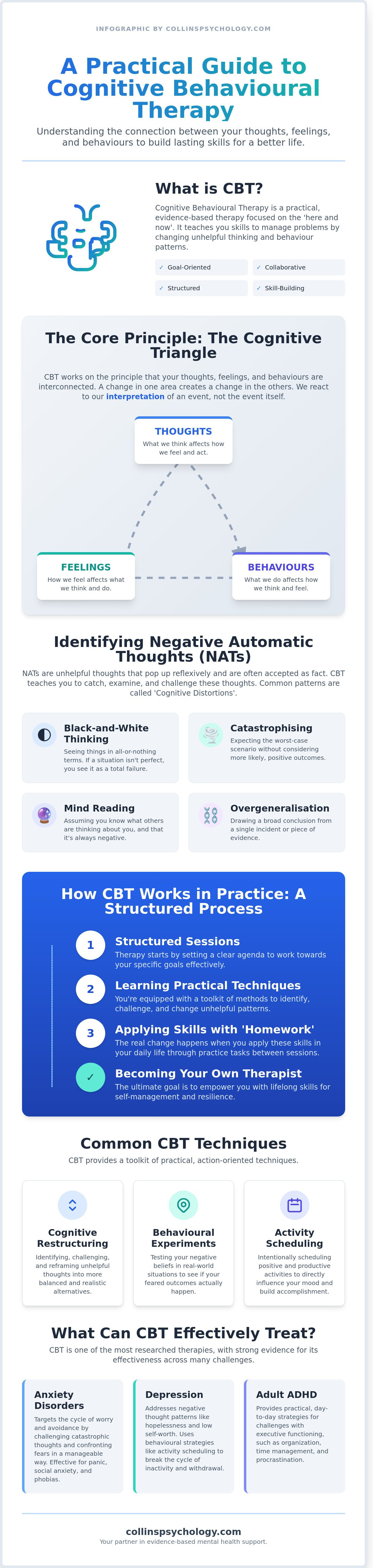
The foundation of CBT can be understood through a simple model: the Cognitive Triangle. This model illustrates how three key elements are linked:
Thoughts
What we think affects how we feel and act.
Feelings
How we feel affects what we think and do. This includes emotions and physical sensations.
Behaviours
What we do affects how we think and feel.
A change in any one of these points will inevitably impact the other two. For example, imagine you are invited to a party. If your thought is, "I will not know anyone and I will say something foolish," you might feel anxious (feeling) and decide not to go (behaviour). This avoidance then reinforces the original thought that you are not good in social situations. CBT highlights that we often react to our interpretation of an event, not the event itself (Greenberger & Padesky, 2015). By learning to change one part of the cycle, such as the thought, you can change the entire outcome.
Identifying Negative Automatic Thoughts (NATs)
We all have a running commentary in our minds. In CBT, the unhelpful thoughts that pop up reflexively are called Negative Automatic Thoughts, or NATs (Beck, 2021). These thoughts are often so ingrained that we accept them as fact without question. They are frequently shorthand versions of deeper beliefs about ourselves, the world, or the future.
The problem arises when these NATs are persistent and dominate our thinking, leading to distress. They often fall into predictable patterns known as cognitive distortions. Common examples include:
Black-and-White Thinking
Seeing things in all-or-nothing terms. If a situation falls short of perfect, you see it as a total failure.
Catastrophising
Expecting the worst-case scenario to happen, without considering other, more likely outcomes.
Mind Reading
Assuming you know what other people are thinking, usually negatively, about you.
Overgeneralisation
Coming to a general conclusion based on a single incident or piece of evidence.
Recognising these thoughts is the first step. CBT teaches you to catch them, examine the evidence for and against them, and develop more balanced and helpful responses (Burns, 1999).
How Does CBT Work in Practice? A Look at the Process
CBT is known for its structured and organised approach. Unlike therapies that are more free-flowing, a CBT process, whether in person or through a guided online programme, typically follows a clear framework. Sessions or modules begin by setting an agenda, ensuring the time is used effectively to work towards your goals.
A central component of CBT is the work done between sessions, often referred to as ‘homework’ or practice tasks. This is crucial because it is where you apply the skills learned in therapy to your real-life situations. The focus is always on making measurable progress towards the specific goals you set at the beginning of the process.
Common CBT Techniques You Will Learn
CBT is not just about talking; it is about doing. It provides a toolkit of practical techniques designed to change unhelpful patterns. Some of the most common include:
Cognitive Restructuring
This is the process of identifying unhelpful thoughts, challenging their validity, and reframing them into more balanced and realistic alternatives. You learn to question your assumptions and look at situations from different perspectives.
Behavioural Experiments
These are real-world tests of your negative beliefs. If you believe, for example, that you will fall apart if you speak up in a meeting, a behavioural experiment might involve preparing one small comment to share. This allows you to see if your feared outcome actually happens.
Activity Scheduling
Particularly useful for low mood and procrastination, this technique involves intentionally scheduling positive and productive activities into your week. This uses behaviour to directly influence your mood and build a sense of accomplishment.
These techniques build practical, lifelong skills for managing your thoughts and emotions.
The Role of 'Homework' in Your Progress
The term ‘homework’ can be misleading; it is better described as practice or skill-building exercises. This is where the real work of CBT happens. Lasting change comes from consistently applying new skills in your daily life, not just from the insights gained in a weekly session.
Examples of these tasks might include:
• Keeping a thought record to track and challenge your NATs.
• Journaling about your experiences with a new behavioural technique.
• Scheduling and completing a task you have been avoiding.
This practice is what makes CBT an efficient and effective therapy. It empowers you to take an active role in your own progress.
What to Expect from a CBT Therapist or Programme
In CBT, a therapist acts more like a coach or a guide than a passive listener. Their role is to teach you skills, provide tools, and help you structure your efforts. It is a collaborative, supportive, and active partnership. Similarly, a well-designed online CBT programme will guide you through this learning process in a structured way. The goal is the same: to provide you with the knowledge and tools to manage challenges independently over time.
What Conditions and Challenges Can CBT Effectively Treat?
CBT is one of the most extensively researched forms of psychotherapy, with a large body of evidence supporting its effectiveness for a wide range of issues (Hofmann et al., 2012). It can be used as a standalone treatment or in conjunction with medication. Its structured, skills-based approach makes it particularly effective for specific, targeted problems.
Anxiety Disorders and Depression
CBT is highly effective for anxiety disorders, as it directly targets the cycle of worry and avoidance. It helps individuals confront their fears in a manageable way and challenge the catastrophic thoughts that fuel conditions like panic disorder, social anxiety, and phobias (Hofmann et al., 2012). For depression, CBT addresses the negative thought patterns, such as hopelessness and low self-worth, that maintain a low mood. It also uses behavioural strategies, like activity scheduling, to help people re-engage with their lives and break the cycle of inactivity and withdrawal. Furthermore, the skills learned in CBT have been shown to be effective in preventing relapse (Teasdale et al., 2000).
Adult ADHD and Executive Functioning Challenges
While many people associate ADHD with medication, CBT can be a powerful tool for addressing the practical, day-to-day challenges that medication does not always resolve. For adults with ADHD, CBT is adapted to focus on building skills in areas of executive functioning (Safren et al., 2010). This includes practical strategies for:
• Time management and organisation.
• Breaking down large tasks to overcome procrastination.
• Managing the intense frustration and emotional dysregulation that can accompany ADHD.
By providing concrete tools and structures, CBT helps adults with ADHD develop systems to manage their responsibilities and reduce the impact of their symptoms on their lives. For more information, you can explore our programmes for adult ADHD.
Other Common Applications
The skills taught in CBT are versatile and can be applied to many other challenges. It is commonly used to treat obsessive-compulsive disorder (OCD), insomnia, relationship problems, and anger management. It has also been successfully adapted for managing the psychological impact of chronic pain and stress, demonstrating the broad applicability of its core principles.
Your CBT Journey: What to Expect from Start to Finish
Embarking on any form of therapy or self-improvement can feel daunting. Understanding the typical stages of the CBT process can help demystify it and reduce any anxiety you may have. The journey is always tailored to an individual's specific goals, but it generally follows a predictable path.
The First Few Sessions: Assessment and Goal-Setting
The initial phase is about building a clear picture of the challenges you are facing and what you want to achieve. This involves an assessment to understand your specific difficulties and history. Together with a therapist, or through a guided programme, you will set clear, measurable, and realistic goals. This creates a roadmap for your work ahead. This stage is also where you learn the fundamentals of the CBT model and how it applies to you.
The Middle Phase: Actively Learning and Applying Skills
This is the core of the work, where you actively learn and practise the techniques of CBT. Sessions or modules will involve reviewing your between-session practice, learning new skills, and planning how to apply them to upcoming situations. Progress is regularly reviewed against the goals you set at the start. This phase is highly interactive and requires your active participation in problem-solving and skill-building.
Ending Therapy: Relapse Prevention and Maintenance
Unlike some other forms of therapy, CBT is designed to have a clear endpoint. The final sessions or modules focus on consolidating the skills you have learned and creating a plan for the future. You will develop a relapse prevention plan, which helps you anticipate future challenges and know how to handle them independently using your new toolkit. The goal is for you to leave feeling confident in your ability to be your own therapist.
Is CBT Right for You and How Do You Get Started?
Deciding to start therapy is a significant step. CBT is a powerful approach, but it is important to assess if it aligns with your needs and preferences. This section will help you consider if CBT is a good fit and provide actionable steps to begin.
Who Benefits Most from the CBT Approach?
CBT tends to work well for people who appreciate a structured, practical, and logical approach to their problems. It is a great fit for individuals who are motivated to take an active role in their own recovery and are willing to practise skills between sessions. If you prefer to focus on current challenges rather than a deep analysis of your past, and you want to learn concrete skills to manage your life more effectively, CBT is an excellent choice.
Finding a Qualified CBT Therapist
If you are seeking one-to-one therapy, it is important to find a therapist with the right credentials and training. In Ireland, you can look for accredited professionals through bodies like the Psychological Society of Ireland (PSI) or the British Association for Behavioural and Cognitive Psychotherapies (BABCP), which accredits therapists across Ireland and the UK. Always check for specific training or certification in CBT and ask about their experience with your particular issue. For those who prefer a more flexible approach, structured online programmes can be an accessible and effective way to learn CBT skills.
Questions to Ask a Potential Therapist
When considering a therapist, do not be afraid to ask questions to ensure they are the right fit for you. Good questions to ask include:
• What is your approach to CBT?
• What does a typical session with you look like?
• How do you measure progress with your clients?
To learn more about our evidence-based, self-paced programmes, you can contact our team.
Frequently Asked Questions (FAQs)
What is the main difference between CBT and other therapies like psychoanalysis?
CBT is a short-term, goal-oriented therapy focused on the 'here and now'. It teaches practical skills to change current thinking and behaviour patterns. Psychoanalysis is a long-term therapy that explores a person's unconscious mind and past experiences, particularly childhood, to understand present difficulties.
How long does Cognitive Behavioural Therapy usually take to see results?
CBT is designed to be a time-limited therapy. While it varies depending on the individual and the problem, many people start to see positive changes within 6 to 8 sessions. A typical course of CBT is often between 12 and 20 sessions.
Is CBT effective? What does the research say?
Yes. CBT is one of the most researched psychotherapies, and extensive studies have shown it to be highly effective for a wide range of conditions, particularly anxiety disorders, depression, and OCD (Hofmann et al., 2012).
Can CBT be done online or does it have to be in person?
CBT can be delivered effectively in various formats, including one-to-one in-person sessions, group therapy, and online through video calls or self-paced programmes. Research has shown that online and computer-based CBT can be just as effective as traditional face-to-face therapy for many conditions.
Will I have to talk about my childhood in CBT?
Generally, no. The primary focus of CBT is on your current thoughts, feelings, and behaviours. While your therapist may ask some questions about your background to understand how your patterns developed, the therapy will not involve a deep, prolonged analysis of your past.
What if I try CBT and it doesn't work for me?
Therapy is not one-size-fits-all. If you find that CBT is not a good fit, it is important to discuss this with your therapist. They may be able to adjust their approach, or it may be that a different type of therapy would be more beneficial for you. The most important thing is finding an approach and a therapist that you connect with.
References
Beck, J. S. (2021). Cognitive behavior therapy: Basics and beyond (3rd ed.). The Guilford Press.
Burns, D. D. (1999). Feeling good: The new mood therapy. Avon Books.
Greenberger, D., & Padesky, C. A. (2015). Mind over mood: Change how you feel by changing the way you think (2nd ed.). The Guilford Press.
Hofmann, S. G., Asnaani, A., Vonk, I. J., Sawyer, A.T., & Fang, A. (2012). The efficacy of cognitive behavioral therapy: A review of meta-analyses. Cognitive Therapy and Research, 36(5), 427–440. https://doi.org/10.1007/s10608-012-9476-1
Safren, S. A., Sprich, S. E., Perlman, C. A., & Otto, M. W. (2010). Mastering your adult ADHD: A cognitive-behavioral treatment program, client workbook (2nd ed.). Oxford University Press.
Teasdale, J. D., Segal, Z. V., Williams, J. M. G., Ridgeway, V. A., Soulsby, J. M., & Lau, M. A. (2000). Prevention of relapse/recurrence in major depression by mindfulness-based cognitive therapy. Journal of Consulting and Clinical Psychology, 68(4), 615–623. https://doi.org/10.1037/0022-006X.68.4.615