.png)

Living with Attention-Deficit Hyperactivity Disorder (ADHD) as an adult involves navigating a world that often isn't designed for your brain's unique wiring. This constant effort can lead to a profound state of exhaustion known as ADHD burnout, a condition that goes beyond simple tiredness. This article explores the specific signs and causes of burnout in adults with ADHD, differentiating it from general workplace stress and depression. We will outline a structured, evidence-based path to recovery, focusing on practical, ADHD-friendly strategies rooted in Cognitive Behavioural Therapy (CBT) to help you reclaim your energy and build a more sustainable life.
What is ADHD Burnout? (And How It Differs from General Burnout)
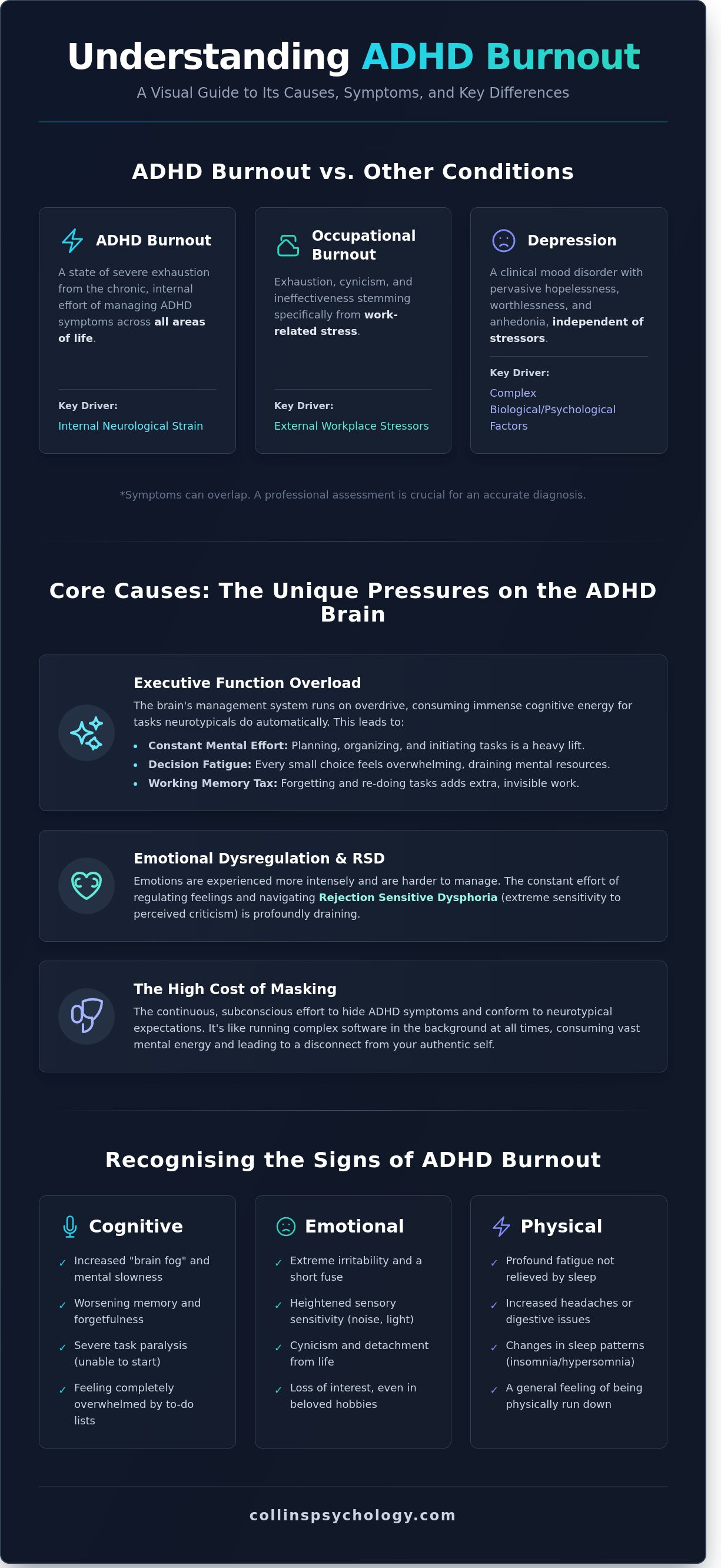
ADHD burnout is a state of severe mental, emotional, and physical exhaustion caused by the chronic stress of living with and managing the symptoms of ADHD. It is not a sign of weakness or laziness; it is the logical outcome of a nervous system and executive function system that has been pushed beyond its capacity for too long (Brown, 2017). People experiencing it often describe feeling like they have "hit a wall," where even the simplest tasks, like answering an email or making a meal, feel monumental. The core difference between ADHD burnout and other forms of burnout is that it stems from the internal, ongoing effort of navigating daily life with an ADHD brain, not just from external stressors.
ADHD Burnout vs. Occupational Burnout
While occupational burnout is a recognised phenomenon, it is primarily linked to stress within a work environment. It is often characterised by feelings of cynicism about one's job, a sense of ineffectiveness, and exhaustion (Maslach & Leiter, 2016).
In contrast, ADHD burnout can occur even without a demanding job. It permeates every area of life, managing household chores, maintaining social relationships, pursuing personal hobbies, and simply trying to stay organised. The relentless demand on your brain to compensate for executive function challenges is the primary driver, making it a whole-life experience rather than a work-specific one.
ADHD Burnout vs. Depression
There is a significant overlap in the symptoms of ADHD burnout and depression, including fatigue, low motivation, and social withdrawal. However, they are distinct conditions. Burnout is typically a response to prolonged, unmanaged stress, whereas depression is a clinical mood disorder with complex biological and psychological roots.
Depression often involves a pervasive sense of hopelessness, worthlessness, and anhedonia (the inability to feel pleasure), which may be present regardless of external stressors. Burnout symptoms, on the other hand, can sometimes be alleviated by removing the source of the stress. Given the similarities, it is crucial to seek a professional assessment from a GP or psychologist for an accurate diagnosis and appropriate support.
The Core Causes: Why ADHD Brains Are Uniquely Prone to Burnout
To understand ADHD burnout, we must look beyond the symptoms to the root causes embedded in the ADHD experience. Living with ADHD requires a constant, invisible effort to manage a world that operates on a neurotypical timeline and set of expectations. This daily exertion slowly depletes energy reserves, making burnout almost inevitable without the right support systems.
Executive Function Overload
The brain’s executive functions are the management system responsible for planning, organising, prioritising, initiating tasks, and regulating focus. For an adult with ADHD, these functions require significantly more conscious effort (Barkley, 2015). This creates a state of executive function overload.
•
Constant mental effort: Simply planning a day, organising a project, or starting a task requires immense cognitive energy.
•
Decision fatigue: Without a reliable internal filter for prioritisation, every choice can feel overwhelming, leading to exhaustion from making countless small decisions.
•
Working memory challenges: Forgetting appointments, misplacing items, or losing your train of thought means you are often re-doing work and expending extra energy just to keep up.
Emotional Dysregulation and Rejection Sensitive Dysphoria (RSD)
Many adults with ADHD experience emotions with greater intensity and have difficulty regulating their responses, a challenge known as emotional dysregulation. This can manifest as rapid shifts from enthusiasm to frustration or from joy to deep disappointment.
Furthermore, many experience Rejection Sensitive Dysphoria (RSD), an extreme emotional sensitivity and pain triggered by the perception of being rejected, teased, or criticised (Dodson, 2016). The constant effort to manage these intense emotional states and the hypervigilance required to avoid perceived rejection is profoundly draining, contributing significantly to burnout.
The High Cost of Masking
Masking is the conscious or subconscious effort to hide ADHD symptoms to fit in with neurotypical expectations. This can include forcing eye contact, suppressing the urge to fidget, meticulously rehearsing conversations, or pretending to focus during meetings.
While masking can be a useful survival strategy, it comes at an enormous cognitive cost. It is like running a complex piece of software in the background of your brain at all times. This constant self-monitoring and suppression consume vast amounts of mental energy, leading to a disconnect from your authentic self and accelerating the path to burnout.
Recognising the Signs: Key Symptoms of ADHD Burnout
Identifying ADHD burnout is the first step toward recovery. The experience can be validating, helping you understand that you are not lazy or broken, you are exhausted. Below is a list of common symptoms, organised by category.
Cognitive and Executive Function Symptoms
•
Increased "brain fog" and a persistent feeling of mental slowness.
•
Worsening memory, such as forgetting names, appointments, or why you walked into a room.
•
Severe task paralysis, where you feel completely unable to start even simple or important tasks.
•
Feeling completely overwhelmed by a to-do list that you might have managed in the past.
Emotional and Psychological Symptoms
•
Extreme irritability and a very short fuse; small frustrations feel enraging.
•
Heightened sensory sensitivity to noise, light, textures, or touch.
•
A sense of cynicism or detachment from work, relationships, and activities.
•
Loss of motivation and interest, even in hobbies and passions you once loved.
Physical Symptoms
•
Profound, bone-deep fatigue that is not relieved by a full night's sleep.
•
Increased frequency of stress-related physical issues, like headaches, migraines, or digestive problems.
•
Changes in sleep patterns, including difficulty falling asleep (insomnia) or wanting to sleep all the time.
•
A general feeling of being unwell or run down, as if you are constantly fighting off an illness.
The Path to Recovery: Evidence-Based Strategies for ADHD Burnout
Recovering from ADHD burnout is not about "pushing through" or "trying harder." It is a process of strategically reducing the demands on your system while actively replenishing your physical and mental resources. Standard advice often falls short because it doesn't account for the unique challenges of the ADHD brain. An ADHD-informed approach is essential.
Step 1: Radical Acceptance and Self-Compassion
The first and most crucial step is to stop fighting your brain and start working with it. Burnout is a signal from your body and mind that your current approach is unsustainable. It is not a personal failure.
•
Acknowledge the reality: Accept that you have ADHD and that it impacts how you function. This is the foundation for finding strategies that actually work.
•
Practice self-compassion: Let go of the guilt and self-criticism. Talk to yourself as you would a friend who is struggling. Acknowledge the incredible effort you have been making every single day.
Step 2: Externalise, Simplify, and Automate
The goal here is to reduce the constant load on your executive functions. By creating external systems of support, you free up precious mental energy.
•
Externalise your brain: Use visual aids like whiteboards, calendars, and sticky notes. Set timers and alarms on your phone. Use apps for to-do lists and reminders to offload the burden from your working memory.
•
Simplify your environment and routines: Declutter your space to reduce distractions. Create simple, repeatable routines for mornings and evenings. Automate anything you can, such as bill payments or grocery deliveries.
•
Embrace "good enough": Perfectionism is a common driver of burnout in adults with ADHD. Give yourself permission to complete tasks to a "good enough" standard instead of striving for an unattainable ideal of perfection.
Step 3: Seek Structured, Professional Support
Trying to recover from burnout alone can be incredibly difficult. A structured approach provides a clear, evidence-based roadmap to guide you. Cognitive Behavioural Therapy (CBT) is highly effective for helping adults with ADHD develop practical skills to manage the core challenges that lead to burnout (Knouse & Safren, 2010). It helps you reframe the negative thought patterns that fuel stress and provides concrete strategies for managing emotions and executive functions.
It is important to note that Collins Psychology provides online, self-paced CBT programmes designed for adults with ADHD; we do not offer one-to-one therapy. Our programmes are created to be flexible, allowing you to learn essential skills at a pace that suits you, with a wealth of resources, exercises, and tools to support your recovery.
Learn how our evidence-based CBT programme can help you manage ADHD and prevent burnout.
Prevention: Building a Sustainable, ADHD-Friendly Lifestyle
Once you begin to recover, the focus shifts to creating a life that prevents future burnout cycles. This is not about "curing" your ADHD but about building an environment and a set of habits that support your brain, allowing you to thrive.
Mastering Energy Management, Not Time Management
For the ADHD brain, energy is a far more valuable resource than time. Traditional time management techniques often fail because they don't account for the interest-driven nature of ADHD motivation.
•
Identify your "dopamine menu": Make a list of activities that reliably energise you and make you feel good. These can be small things, like listening to a favourite song, or bigger things, like a walk in nature. Intentionally incorporate these into your day.
•
Recognise early warning signs: Learn to identify the subtle signals your body sends when your energy is getting low (e.g., increased irritability, difficulty focusing).
•
Schedule intentional rest: Treat downtime, relaxation, and "do-nothing" time as non-negotiable appointments in your calendar.
Setting and Enforcing Boundaries
Burnout is often caused by taking on too much. Boundaries are the rules you set to protect your time, energy, and mental well-being.
•
Learn to say "no": Politely decline requests and commitments that you know will overextend you.
•
Protect your energy: Identify people, situations, or environments that consistently drain you and limit your exposure to them.
•
Communicate your needs: Clearly and calmly express your needs to your partner, family, and colleagues. For example, "I need 30 minutes of quiet time after work to decompress."
Finding Support and Community
Feeling misunderstood is a major source of stress for adults with ADHD. Connecting with others who share your experience can be a powerful antidote to the isolation and exhaustion that comes from masking.
•
Reduce isolation: Seek out online forums, local support groups, or friends who also have ADHD.
•
Build your support system: Cultivate relationships with people who understand and support you, whether it's a partner, a friend, or a family member.
•
Share your experience: Knowing you are not alone on this journey provides immense validation and relief, which are crucial for long-term well-being.
Frequently Asked Questions (FAQs)
How is ADHD burnout different from clinical depression?
While symptoms like fatigue and low motivation overlap, burnout is primarily a response to chronic stress, and its symptoms may lessen when the stressors are removed. Depression is a mood disorder often characterised by pervasive feelings of worthlessness and an inability to feel pleasure, regardless of circumstances. A professional assessment is vital to distinguish between the two.
How long does it take to recover from ADHD burnout?
Recovery time varies for each individual and depends on the severity of the burnout and the changes you are able to implement. It is a gradual process of reducing demands and replenishing resources. For some, it may take a few months; for others, it could be longer. Patience and self-compassion are key.
Can an online CBT programme help with burnout symptoms?
Yes, a structured, self-paced CBT programme can be very effective. It provides the tools and strategies to manage executive function challenges and emotional dysregulation, the root causes of ADHD burnout—in a flexible format that you can adapt to your energy levels.
Is burnout an inevitable part of living with ADHD?
Burnout is a high risk for adults with ADHD, but it is not inevitable. By understanding your brain, implementing ADHD-friendly strategies, setting boundaries, and building a supportive environment, you can create a sustainable lifestyle that significantly reduces the likelihood of burnout.
What's the first step I should take if I think I have ADHD burnout?
The most important first step is to acknowledge what you are experiencing without judgement. Recognise that this is a legitimate response to chronic stress, not a personal failing. The next step is to begin reducing demands wherever possible, start saying "no," simplify your to-do list, and prioritise rest.
References
Barkley, R. A. (2015). Attention-deficit hyperactivity disorder: A handbook for diagnosis and treatment (4th ed.). The Guilford Press.
Brown, T. E. (2017). Outside the box: Rethinking ADD/ADHD in children and adults: A practical guide. American Psychiatric Association Publishing.
Dodson, W. (2016). Emotional regulation & rejection sensitivity. CHADD Annual International Conference.
Knouse, L. E., & Safren, S. A. (2010). Current status and future directions in cognitive behavioral therapy for adult ADHD. Cognitive and Behavioral Practice, 17(4), 407–419.
Maslach, C., & Leiter, M. P. (2016). Understanding the burnout experience: Recent research and its implications for psychiatry. World Psychiatry, 15(2), 103–111. https://doi.org/10.1002/wps.20311