.png)

Understand the deep connection between ADHD and social anxiety, and discover structured, evidence based strategies to build confidence and manage symptoms. This guide explores why social situations can feel so challenging for adults with ADHD, helps differentiate between the two conditions, and outlines practical, Cognitive Behavioural Therapy (CBT) informed approaches to help you navigate your social world with greater ease and self assurance.
The Connection: Why Adults with ADHD Often Experience Social Anxiety
It is common for adults with Attention Deficit Hyperactivity Disorder (ADHD) to also experience social anxiety. Research indicates that a significant percentage of adults with ADHD will meet the criteria for an anxiety disorder at some point in their lives, with social anxiety disorder being particularly prevalent (Fayyad et al., 2017; Michielsen et al., 2023). This is not a coincidence but often a result of the interplay between core ADHD traits and social expectations. The challenges inherent in ADHD, such as difficulties with attention, impulse control, and emotional regulation, can create fertile ground for social anxiety to develop. This section explores the 'why' behind this common and often distressing experience.
Executive Function Challenges in Social Settings
Executive functions are the brain's management system, and they are essential for smooth social interaction. For adults with ADHD, impairments in these functions can make socialising feel like a complex and error prone task (Barkley, 2015).
Working memory
deficits can make it difficult to keep track of conversations, remember names, or recall what you were about to say. This can lead to moments of feeling lost or appearing uninterested.
Poor self monitoring
can result in interrupting others, oversharing personal information, or talking excessively without noticing social cues that suggest it is time to stop.
Difficulties with planning and organisation
can affect everything from remembering to RSVP to arriving at an event on time, which can be misinterpreted by others as a lack of care or respect.
Over time, a history of these small, perceived social 'failures' can build up, creating a belief that you are simply not good at socialising.
Emotional Dysregulation and Rejection Sensitivity
A core, though often overlooked, aspect of ADHD is difficulty with emotional regulation, which involves managing the intensity and duration of emotional responses (Shaw et al., 2014). This is closely linked to a phenomenon many with ADHD experience known as rejection sensitivity. This is not a formal diagnosis but describes an intense, painful emotional reaction to perceived or real rejection, criticism, or failure. This extreme fear of being judged or disliked is the central fear in social anxiety disorder. When you are acutely sensitive to any hint of disapproval, you naturally become hyper vigilant and fearful in social situations where judgement feels possible.
The Impact of Past Negative Social Experiences
For many adults, their ADHD was not diagnosed until later in life. This means they navigated the complex social worlds of childhood and adolescence without understanding why they struggled. These formative years may have included experiences of being criticised by teachers for 'not paying attention', being excluded by peers for being 'too much', or even being bullied. These painful events can lead to the formation of deeply ingrained negative core beliefs, such as 'I am annoying' or 'People do not like me'. In adulthood, these beliefs act as a filter, causing you to interpret ambiguous social situations negatively and fuelling the avoidance and fear that characterise social anxiety (Clark & Wells, 1995).
Is It Social Anxiety or ADHD? How to Tell the Difference
The significant overlap in the outward appearance of ADHD social challenges and social anxiety disorder can be confusing. You might wonder if your difficulty in groups is due to a fear of judgement or an inability to focus. The key difference often lies in the underlying reason for the behaviour. While a formal diagnosis from a qualified professional is always necessary, understanding these distinctions can provide clarity.
Core Fear vs. Cognitive Distraction
The primary motivation behind the behaviour is a critical differentiator.
Social Anxiety
The main driver is an intense fear of negative evaluation. A person with social anxiety is preoccupied with thoughts like, 'They think I'm boring,' or 'I'm going to say something stupid and embarrass myself'. They do not listen because their mental energy is consumed by monitoring themselves and others for signs of disapproval.
ADHD
The main driver is often cognitive. The ADHD brain is pulled away by internal thoughts or external stimuli. A person with ADHD may not be listening because they are distracted by a noise outside, are thinking about an unrelated interesting idea, or are struggling to sustain mental effort on the conversation (Barkley, 2015). The internal monologue is one of distraction, not necessarily fear.
Avoidance: Fear Based vs. Overwhelm Based
Both conditions can lead to avoiding social events, but for different reasons.
• A person with social anxiety avoids events primarily to prevent the possibility of being judged, scrutinised, or humiliated. The avoidance is a direct response to fear.
• A person with ADHD may avoid events because they find them overstimulating, with too much noise and too many people to track. They may also avoid situations they find under stimulating or boring. This avoidance is often about managing sensory input or a low 'social battery', rather than a fear of judgement. Sometimes, avoidance is simply due to executive function failure, such as forgetting the event was happening.
Comparison Table: ADHD Social Challenges vs. Social Anxiety Disorder
| Social Challenge | ADHD Based Reason | Social Anxiety Disorder Based Reason |
|---|---|---|
| Interrupting Others | Impulsivity; speaking before a thought is fully formed or forgotten. Difficulty waiting for a turn. | Anxious urgency to say the 'right' thing before the moment passes, or to prevent an awkward silence. |
| Difficulty in Groups | Overstimulation from multiple conversations. Trouble tracking who is speaking and filtering background noise. | Intense fear of being scrutinised by multiple people. Feeling exposed and on display. |
| Avoiding Social Events | The event seems boring or overwhelming. Forgetting to RSVP or a lack of energy (social burnout). | Fear of being judged negatively, saying the wrong thing, or having a panic attack in front of others. |
| After Event Thoughts | Replaying impulsive comments with regret ('Why did I say that?'). Frustration over missed details. | Ruminating on perceived social mistakes and scanning the memory for evidence of being disliked or judged. |
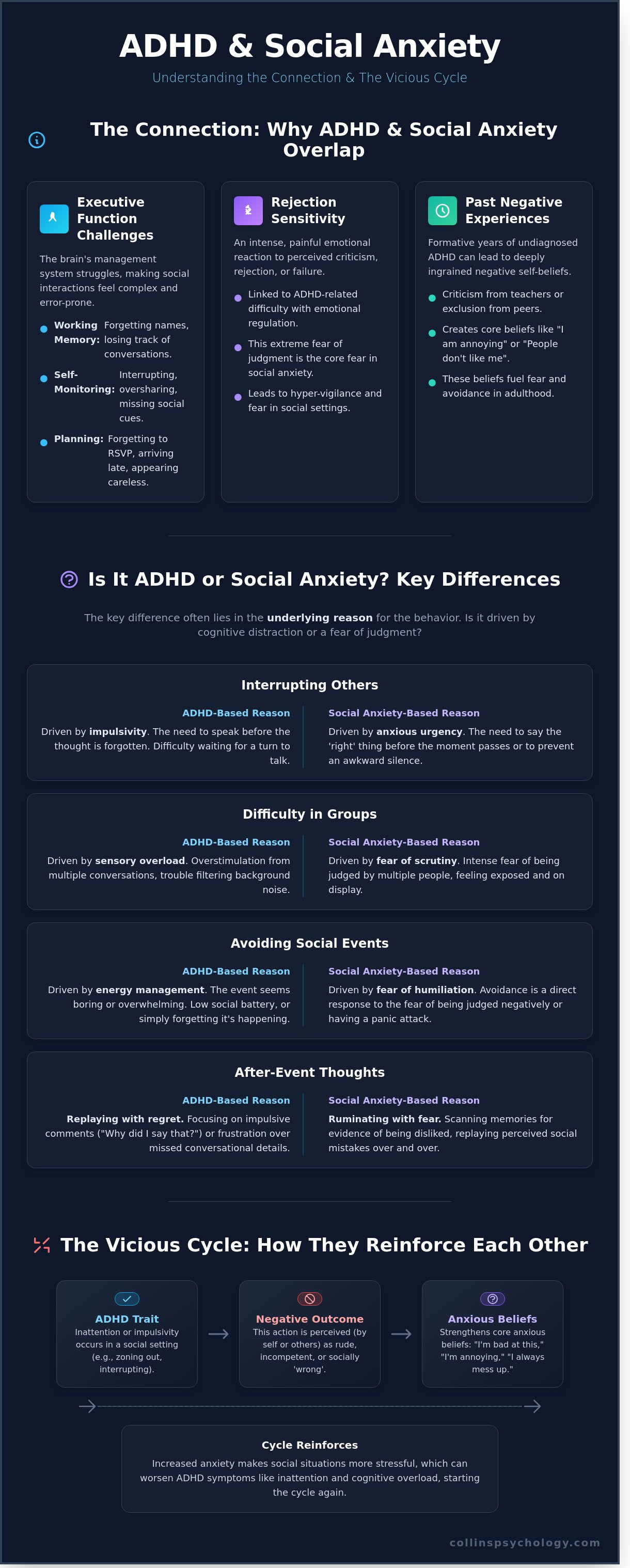
The Vicious Cycle: How ADHD and Social Anxiety Reinforce Each Other
ADHD and social anxiety do not just coexist; they can create a debilitating, self perpetuating cycle. Each condition can actively worsen the symptoms of the other, making it feel impossible to break free. Understanding this cycle is the first step toward dismantling it.
How Inattention and Impulsivity Fuel Social Fears
ADHD traits can inadvertently create the very social outcomes that a person with social anxiety fears most.
Inattention
can cause you to miss a social cue, forget someone's name moments after they said it, or 'zone out' mid conversation. These moments can be perceived by others as rude or by yourself as evidence of your social incompetence, which strengthens the anxious belief, 'I am bad at this'.
Impulsivity
might lead you to blurt out a comment that feels inappropriate in hindsight. This can lead to intense post event shame and regret, which in turn heightens the fear of making similar 'mistakes' in the future.
How Anxiety Impairs Already Strained Executive Functions
Anxiety places a significant load on the brain's cognitive resources, particularly on working memory (Moran, 2016). For the ADHD brain, where executive functions are already strained, this can be debilitating.
• The 'brain fog' of anxiety consumes the mental bandwidth needed to follow a conversation, think of a response, or manage impulses.
• The intense fear of 'messing up' can lead to a state of mental freezing, where your mind goes completely blank.
• This experience then serves as powerful confirmation for the anxious mind: 'See, I cannot even think straight around people. There is something wrong with me'.
The Role of Masking and Social Burnout
To cope, many adults with ADHD engage in 'masking' or 'camouflaging', which involves consciously hiding their traits to fit in (Miller et al., 2022). This might look like forcing eye contact, manually suppressing the urge to fidget, or carefully scripting conversations. This constant, exhausting self monitoring prevents genuine connection and significantly increases anxiety. It leads to social burnout, which reinforces the belief that socialising is draining and difficult, strengthening the desire to avoid it altogether.
Evidence Based Strategies to Manage Both Conditions
While the interaction between ADHD and social anxiety is complex, it is not unmanageable. The focus must shift from problems to structured, actionable solutions. Cognitive Behavioural Therapy (CBT) is a highly effective psychological approach for social anxiety, and specific adaptations make it particularly well suited for the ADHD brain (Safren et al., 2017). The goal is to provide a clear path forward, built on practical and sustainable strategies.
Cognitive Behavioural Therapy (CBT) for ADHD and Anxiety
CBT provides a structured framework for understanding and changing the patterns that maintain social anxiety. It works by helping you to:
Identify and challenge anxious thought patterns
Learn to catch automatic negative thoughts (e.g., 'Everyone is staring at me') and examine the evidence for and against them.
Conduct behavioural experiments
Gradually and systematically face feared social situations to learn that your feared outcomes are often unlikely or manageable. This provides direct evidence to contradict anxious beliefs.
Develop balanced thinking
Move away from catastrophic, black and white thinking towards more realistic and compassionate self talk.
A structured, skills based approach like CBT is often very effective for the ADHD brain, which benefits from clear steps and practical tools.
Practical Skills for Navigating Social Situations
Beyond core CBT, specific skills can help manage ADHD traits in the moment.
Manage working memory
Do not be afraid to ask for clarification. Saying, "Sorry, my mind just blanked for a second, could you repeat that?" is often better than trying to guess what was said.
Manage impulsivity
Practice the 'pause'. Before speaking, take a quick breath and ask yourself, 'Is this helpful? Is this relevant?'. This brief moment can make a significant difference.
Plan for overwhelm
Give yourself permission to take breaks at social gatherings. Stepping outside for a few minutes of quiet can help reset your system. Having a planned 'exit strategy' (e.g., 'I can only stay for an hour') can also reduce the feeling of being trapped.
Lifestyle and Environmental Accommodations
Making deliberate choices about your social life can reduce anxiety and prevent burnout.
Choose your environment
Opt for smaller, quieter settings over large, loud, and crowded venues when possible. A conversation with two friends in a quiet cafe is less demanding on your executive functions than a large party.
Schedule recovery time
Plan for downtime after social events. Acknowledge that socialising takes energy, and allow yourself time to recharge without guilt.
Prioritise fundamentals
Consistent sleep, regular physical activity, and a balanced diet are foundational for regulating both anxiety and ADHD symptoms.
Practice self compassion
Acknowledge that navigating the social world with both ADHD and social anxiety is genuinely difficult. Celebrate small victories, such as staying at an event for ten minutes longer than you planned, and treat yourself with the same kindness you would offer a friend.
Navigating the complexities of co occurring ADHD and social anxiety requires a structured and supportive approach. Our online programmes are designed to provide you with the CBT skills to manage these challenges. It is important to note that these are self paced educational programmes and not a form of one to one therapy. To learn practical strategies for building social confidence and managing your symptoms, explore our structured CBT programme for Adult ADHD.
Frequently Asked Questions
What is the difference between social anxiety and just being an introvert?
Introversion is a personality trait where individuals gain energy from spending time alone and may find socialising tiring. An introvert might choose to have a quiet night in because it is more restorative and enjoyable for them. Social anxiety is a mental health condition characterised by an intense fear of negative judgement in social situations. A person with social anxiety might stay home not because they prefer to, but because they are afraid of being embarrassed or rejected.
Can you develop social anxiety later in life because of ADHD?
Yes, it is quite common. Many adults with undiagnosed ADHD accumulate a lifetime of negative social feedback. The repeated experiences of being misunderstood, criticised, or feeling 'out of sync' can lead to the development of deep seated beliefs that you are socially inept. These beliefs can then crystallise into social anxiety disorder in adulthood.
What is the first step I should take if I think I have both conditions?
The most important first step is to seek a comprehensive assessment from a qualified healthcare professional, such as a clinical psychologist or a psychiatrist. A thorough evaluation is needed to understand your specific symptoms, make an accurate diagnosis, and develop an appropriate and effective management plan.
How do I find a therapist who understands both ADHD and social anxiety?
Look for a mental health professional who explicitly states they have experience working with adults with neurodevelopmental conditions. It is helpful to ask about their therapeutic approach; professionals trained in Cognitive Behavioural Therapy (CBT) are often well equipped to handle this combination. While we do not offer individual therapy, our programmes are designed to teach you these essential CBT skills.
Should I seek therapy or medical advice for these issues?
Psychological therapies like CBT are considered a primary and highly effective approach for managing social anxiety. For some individuals, medication may also be a helpful component of a comprehensive plan. The decision about what is right for you should be made in consultation with a qualified professional, such as your GP or a psychiatrist, who can assess your overall health and discuss all available options.
Are online therapy programmes effective for managing social anxiety and ADHD?
For many people, structured online programmes can be a very effective and accessible way to learn evidence based skills. They offer the flexibility to learn at your own pace, which can be ideal for the ADHD brain. Online CBT programmes can provide the tools, knowledge, and exercises needed to challenge anxious thoughts and change behaviours, empowering you to manage your symptoms more effectively.
References
Barkley, R. A. (2015). Attention-deficit hyperactivity disorder: A handbook for diagnosis and treatment (4th ed.). The Guilford Press.
Clark, D. M., & Wells, A. (1995). A cognitive model of social phobia. In R. G. Heimberg, M. R. Liebowitz, D. A. Hope, & F. R. Schneier (Eds.), Social phobia: Diagnosis, assessment, and treatment (pp. 69–93). The Guilford Press.
Fayyad, J., Sampson, N. A., Hwang, I., Adamowski, T., Aguilar-Gaxiola, S., Al-Hamzawi, A., ... & Kessler, R. C. (2017). The descriptive epidemiology of DSM-IV adult ADHD in the World Health Organization World Mental Health Surveys. ADHD Attention Deficit and Hyperactivity Disorders, 9(1), 47–65. https://doi.org/10.1007/s12402-016-0208-3
Michielsen, M., Semeijn, E., Comijs, H. C., van de Ven, P., van den Bree, M., & De-Wit, L. (2023). The longitudinal association between ADHD and social anxiety disorder from adolescence to young adulthood. European Child & Adolescent Psychiatry, 32(12), 2465–2474. https://doi.org/10.1007/s00787-022-02118-z
Miller, A. C., Ghadery, A., & Tickle, A. (2022). ‘It has been a lifetime of trying to be somebody else’: A qualitative study of camouflaging in adults with ADHD. ADHD Attention Deficit and Hyperactivity Disorders, 14(4), 373–386. https://doi.org/10.1007/s12402-022-00392-4
Moran, T. P. (2016). Anxiety and working memory capacity: A meta-analysis. Psychological Bulletin, 142(8), 831–864. https://doi.org/10.1037/bul0000051
Safren, S. A., Sprich, S. E., Perlman, C. A., & Otto, M. W. (2017). Mastering your adult ADHD: A cognitive-behavioral treatment program, therapist guide (2nd ed.). Oxford University Press.
Shaw, P., Stringaris, A., Nigg, J., & Leibenluft, E. (2014). Emotion dysregulation in attention deficit hyperactivity disorder. American Journal of Psychiatry, 171(3), 276–293. https://doi.org/10.1176/appi.ajp.2013.13070966
Skirrow, C., & Asherson, P. (2013). Emotional lability, comorbidity and impairment in adults with attention-deficit hyperactivity disorder. Journal of Affective Disorders, 147(1-3), 80–86. https://doi.org/10.1016/j.jad.2012.10.011