.png)

Procrastination is a common challenge for many, but for adults with Attention Deficit Hyperactivity Disorder (ADHD), it can be a persistent and overwhelming obstacle affecting work, relationships, and self-esteem. This is not a matter of laziness or a lack of willpower; it is a complex issue rooted in the neurobiology of ADHD. This article explores the deep connection between ADHD and procrastination, offering evidence-based strategies and practical tools to help you understand and manage this challenge, moving from a cycle of delay to a path of productivity and self-compassion.
Understanding Procrastination in Adults with ADHD
Procrastination is the act of delaying or postponing tasks despite knowing there will be negative consequences for doing so (Steel, 2007). While everyone procrastinates occasionally, for adults with ADHD, it is often a chronic and debilitating pattern. The difficulty lies not in wanting to do the task, but in the inability to initiate and sustain action. This persistent delay is directly linked to the core symptoms and neurological underpinnings of ADHD, impacting everything from simple household chores to critical career deadlines.
The Link Between ADHD and Procrastination
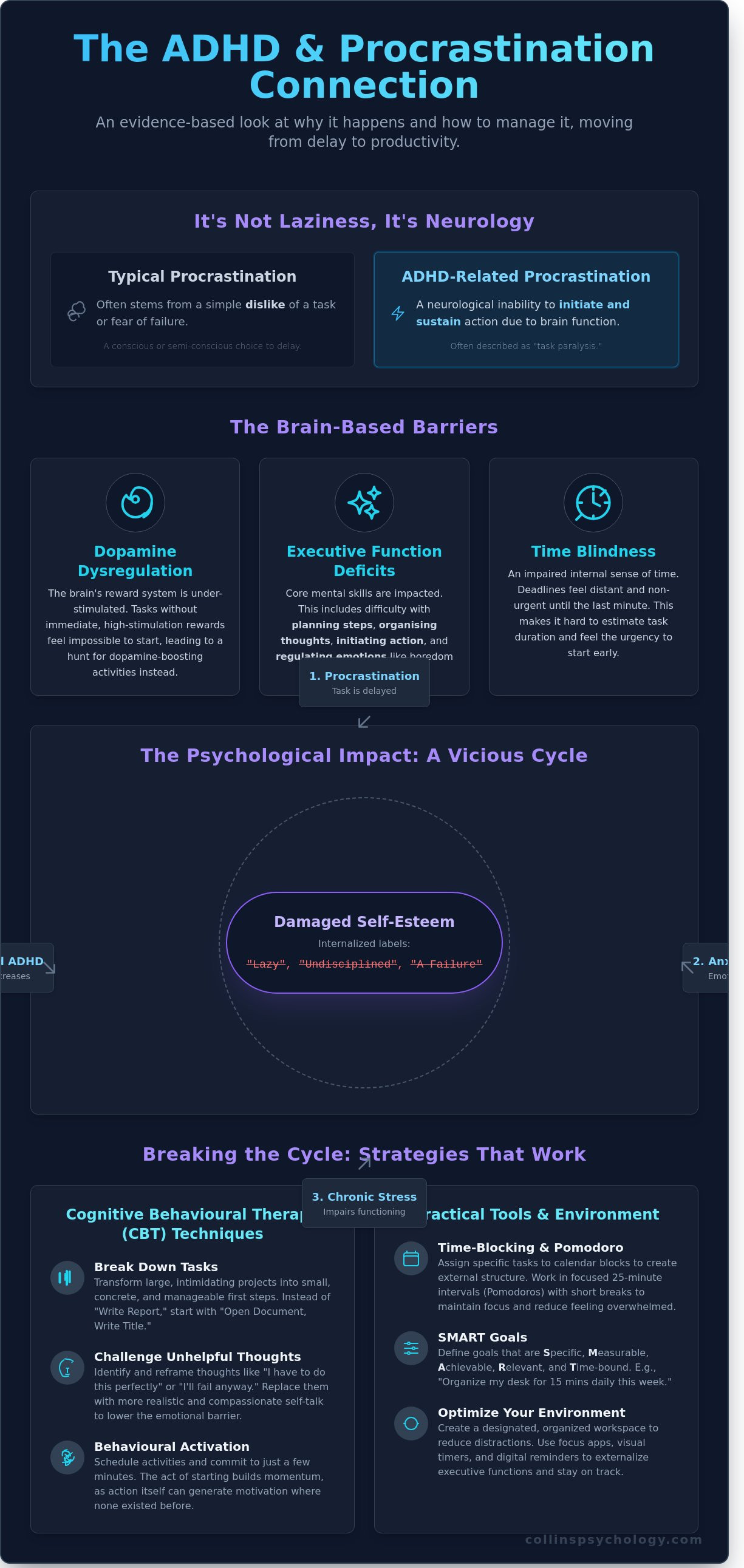
The connection between ADHD and procrastination is grounded in challenges with executive functions, the set of mental skills that include planning, organising, and initiating tasks (Brown, 2005). The ADHD brain functions differently, particularly in regions responsible for these skills. Key factors include:
Dopamine Dysregulation
Dopamine is a neurotransmitter crucial for motivation and reward. In individuals with ADHD, the dopamine system is often dysregulated, making it difficult to feel motivated for tasks that do not offer immediate or high-stimulation rewards. This can lead to a state of "task paralysis" where you know what you need to do but cannot seem to start.
Executive Function Deficits
ADHD directly impacts executive functions like task initiation, time management, and emotional regulation. A task may feel overwhelming because the steps to complete it are unclear, or the emotional discomfort associated with it (boredom, anxiety, frustration) is too intense to overcome in the moment (Barkley, 2015).
Time Blindness
Many adults with ADHD struggle with an internal sense of time, making it difficult to accurately estimate how long a task will take or to feel the urgency of a future deadline. This "time blindness" means deadlines do not feel real until they are imminent, triggering a last-minute rush of stress-fuelled activity.
This differs significantly from typical procrastination, which might stem from a simple dislike of a task. For an adult with ADHD, the barrier is often neurological. The brain is not providing the necessary activation signals to begin, especially for tasks perceived as boring, difficult, or overwhelming.
Psychological Impact of Procrastination
The constant struggle with procrastination takes a significant emotional and mental toll. It can create a vicious cycle that reinforces negative self-perceptions and worsens ADHD symptoms.
Emotional and Mental Effects
The cycle often involves intense anxiety before a task, followed by guilt and frustration during the period of delay. This can lead to chronic stress, which further impairs executive functioning and makes it even harder to initiate tasks.
Impact on Self-Esteem
Repeatedly failing to meet deadlines or personal goals can severely damage self-esteem. Adults with ADHD may internalise these struggles, labelling themselves as "lazy," "undisciplined," or "a failure," without recognising the underlying neurobiological reasons for their difficulties.
Exacerbation of ADHD Symptoms
The stress caused by procrastination can heighten other ADHD symptoms, such as inattention and emotional dysregulation. This creates a feedback loop where procrastination leads to stress, and stress makes it even more difficult to manage ADHD and start tasks.
Strategies to Manage Procrastination
Overcoming procrastination with ADHD requires more than just trying harder. It involves using structured strategies that work with your brain, not against it. Approaches like Cognitive Behavioural Therapy (CBT), combined with practical time management and goal-setting techniques, provide a framework for building new habits and breaking the cycle of delay.
Structured Approaches and CBT Techniques
Cognitive Behavioural Therapy (CBT) is an effective therapeutic approach for managing the challenges of adult ADHD, including procrastination (Ramsay & Rostain, 2015). CBT helps you identify and change unhelpful thought patterns and behaviours. For procrastination, this involves:
Breaking Down Tasks
A common CBT technique is to break large, intimidating projects into small, manageable steps. Instead of "write report," the first step might be "open a new document and write a title." This reduces the feeling of being overwhelmed and makes it easier to start.
Challenging Unhelpful Thoughts
CBT helps you recognise and reframe negative thoughts that fuel procrastination, such as "I have to do this perfectly" (perfectionism) or "I'll fail anyway, so why bother?" (catastrophising). By replacing them with more realistic and compassionate thoughts, you can lower the emotional barrier to starting.
Behavioural Activation
This involves scheduling activities and committing to doing them for just a few minutes. The goal is to build momentum, as action itself can often generate motivation.
Our online programmes are built on these CBT principles, providing structured modules to guide you through these techniques.
Time Management and Goal Setting
Effective time management for an ADHD brain often looks different from traditional methods. It needs to be visual, flexible, and account for challenges with focus and motivation.
Time-Blocking and Pomodoro Technique
Instead of a simple to-do list, time-blocking involves assigning specific tasks to specific times in your calendar. This creates an external structure. The Pomodoro Technique, which involves working in focused 25-minute intervals with short breaks, can help maintain focus and make tasks feel less daunting.
SMART Goals
Setting clear and achievable goals is crucial. The SMART framework helps ensure your goals are Specific, Measurable, Achievable, Relevant, and Time-bound (Doran, 1981). For example, instead of "get organised," a SMART goal would be "spend 15 minutes every day this week organising my desk."
Practical Tools and Techniques
In addition to strategies, using the right tools and creating a supportive environment can make a significant difference in managing procrastination. These tools act as external aids for executive functions that may be internally inconsistent.
Digital Tools to Combat Procrastination
Technology can be a powerful ally when used intentionally. Many applications and digital tools are designed to support focus and organisation.
Focus-Enhancing Apps
Applications that block distracting websites, play ambient sounds, or guide you through focus intervals can help create a digital environment conducive to work.
Reminders and Timers
Use digital calendars, reminder apps, and timers to externalise your time management. Visual timers can be particularly helpful for making the passage of time more concrete and tangible.
Our online modules explore a variety of digital tools and provide guidance on how to integrate them effectively into your daily routine.
Creating a Procrastination-Free Environment
Your physical surroundings have a major impact on your ability to focus and initiate tasks. Optimising your environment can reduce the friction between you and your work.
Workspace Organisation
A cluttered workspace can be visually distracting and overwhelming. Designate a specific place for work and keep it as tidy as possible. Ensure everything you need is within easy reach to avoid getting sidetracked looking for supplies.
Minimising Distractions
Identify your biggest distractions and create barriers to them. This might mean putting your phone in another room, using noise-cancelling headphones, or letting others know when you need uninterrupted time to focus.
The Role of Professional Guidance
While self-help strategies are valuable, the support and structure of a formal programme can be instrumental in creating lasting change. Understanding the principles of CBT and learning how to apply them consistently is key to overcoming procrastination associated with ADHD.
Therapy and Coaching for ADHD
Structured therapeutic approaches provide a clear path for developing skills. CBT, for instance, offers a well-researched framework for addressing the thought patterns and behaviours that underpin procrastination in ADHD (Knouse & Safren, 2010). A guided programme can help you implement these strategies systematically and troubleshoot challenges along the way.
Personalised ADHD Management Programmes
At Collins Psychology, we provide online, self-paced CBT programmes designed for adults with ADHD. It is important to note that we do not offer one-to-one therapy. Instead, our programmes deliver structured, evidence-based content through a flexible online platform. This allows you to learn and apply practical strategies for managing procrastination, time management, and emotional regulation at your own pace, with a wealth of resources, exercises, and tools at your fingertips.
If you are ready to build effective skills for managing procrastination, we invite you to Explore our ADHD Therapy Programmes.
Long-Term Success and Maintenance
Overcoming procrastination is not a one-time fix but an ongoing process of building and maintaining new habits. Long-term success depends on self-awareness, adaptability, and self-compassion.
Motivation and Relapse Prevention
Motivation can fluctuate, and it is normal to have days where procrastination feels more powerful. The key is to recognise potential triggers for relapse, such as stress, fatigue, or unstructured time, and have a plan to address them. Techniques like reconnecting with your "why" (the deeper reason for completing a task) and celebrating small wins can help sustain momentum. It is crucial to treat setbacks not as failures, but as learning opportunities to adjust your strategies.
Continuous Learning and Adaptation
The strategies that work for you today may need to be adapted in the future as your life circumstances change. Stay curious about how your brain works and be open to trying new tools and techniques. Engaging with supportive communities, whether online or in person, can also provide encouragement and new ideas. The goal is to build a personalised toolkit of strategies that you can draw upon throughout your life.
Frequently Asked Questions
What is the relationship between ADHD and procrastination?
The relationship is neurobiological. Procrastination in adults with ADHD is primarily caused by executive function challenges, including difficulty with task initiation, time management, and emotional regulation, which are core features of the condition. It is not a reflection of character or laziness.
How can adults with ADHD effectively manage procrastination?
Effective management involves using structured, multi-faceted strategies. This includes breaking tasks into smaller steps, using time management techniques like the Pomodoro method, optimising one's environment to reduce distractions, and applying Cognitive Behavioural Therapy (CBT) techniques to change unhelpful thought patterns.
What are some CBT techniques for reducing procrastination?
Key CBT techniques include cognitive restructuring to challenge perfectionistic or catastrophic thinking, behavioural activation to start a task for just a few minutes to build momentum, and activity scheduling to create external structure and accountability.
What role do digital tools play in managing ADHD-related procrastination?
Digital tools can act as external aids for executive functions. Focus apps can block distractions, digital calendars and reminders can help with planning and time blindness, and project management tools can help break down and visualise complex tasks.
How can professional guidance assist in overcoming procrastination?
Structured programmes, like the self-paced online CBT programmes offered by Collins Psychology, provide an evidence-based framework and a clear path for skill development. They teach proven strategies in a systematic way, helping individuals build the habits needed to manage procrastination effectively over the long term.
References
Barkley, R. A. (2015). Attention-deficit hyperactivity disorder: A handbook for diagnosis and treatment (4th ed.). The Guilford Press.
Brown, T. E. (2005). Attention deficit disorder: The unfocused mind in children and adults. Yale University Press.
Doran, G. T. (1981). There's a S.M.A.R.T. way to write management's goals and objectives. Management Review, 70(11), 35–36.
Knouse, L. E., & Safren, S. A. (2010). Current status of cognitive behavioral therapy for adult ADHD. Journal of Consulting and Clinical Psychology, 78(6), 790–800. https://doi.org/10.1037/a0020973
Ramsay, J. R., & Rostain, A. L. (2015). Cognitive-behavioral therapy for adult ADHD: An integrative psychosocial and medical approach (2nd ed.). Routledge.
Steel, P. (2007). The nature of procrastination: A meta-analytic and theoretical review of quintessential self-regulatory failure. Psychological Bulletin, 133(1), 65–94. https://doi.org/10.1037/0033-2909.133.1.65