.png)

This guide explains the science behind the mental fatigue so common with ADHD and provides evidence-based strategies to help you manage exhaustion and reclaim your energy. It is designed to offer understanding and practical, low-effort techniques you can implement immediately, as well as long-term approaches rooted in Cognitive Behavioural Therapy (CBT). Our programmes are self-paced online learning modules, designed to be completed at your convenience. We do not provide one-to-one therapy.
What is ADHD Mental Fatigue? (And Why It's Not Just 'Feeling Tired')
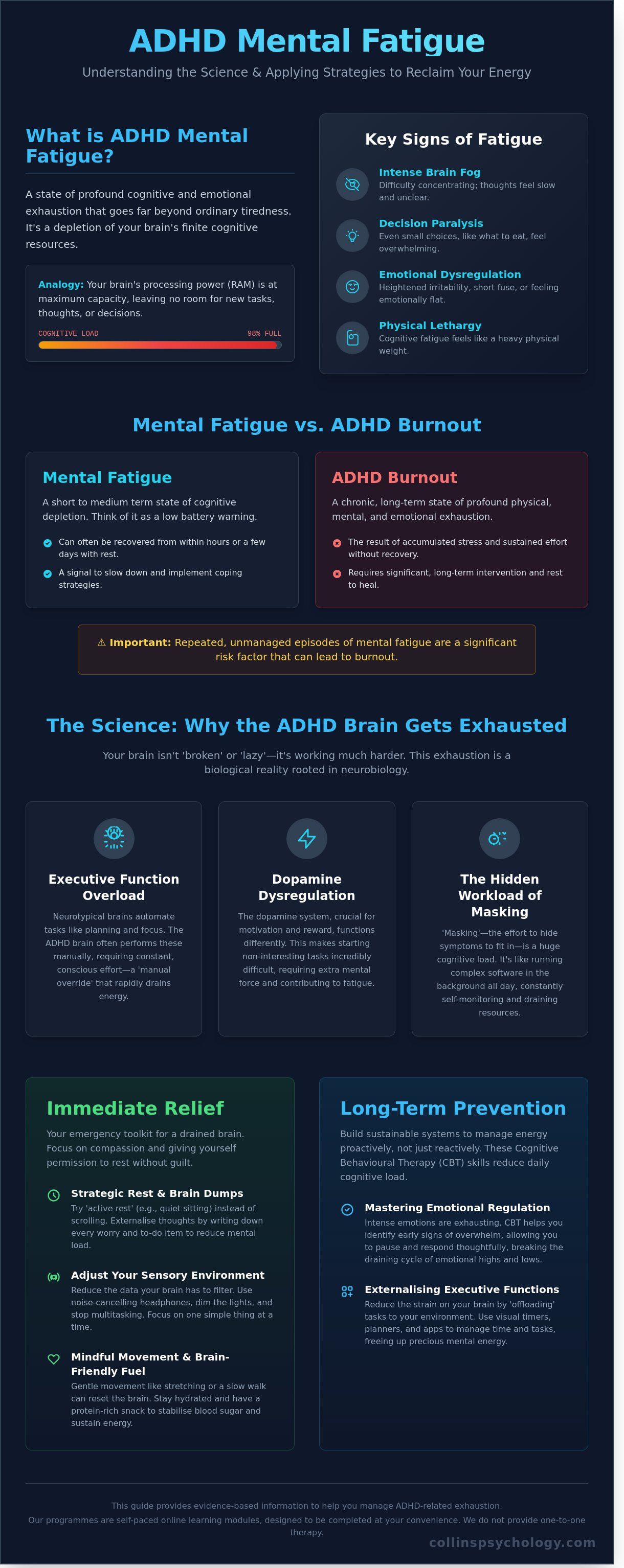
Mental fatigue is a state of profound cognitive and emotional exhaustion that goes far beyond ordinary tiredness. If you have Attention Deficit Hyperactivity Disorder (ADHD), this feeling is likely a familiar, and often frustrating, part of your daily life. A useful analogy is to think of your brain’s processing power or RAM. When you experience mental fatigue, it is as if every bit of that RAM is being used up, leaving no capacity for new tasks, thoughts, or decisions (Fuermaier et al., 2021). This is a common but frequently misunderstood experience for adults with ADHD, and it is crucial to differentiate it from physical tiredness that comes from exertion or a simple lack of sleep. Mental fatigue is a depletion of your cognitive resources.
Key Signs of ADHD-Related Mental Fatigue
While it can manifest differently for everyone, several key signs point towards ADHD-related mental fatigue:
Intense brain fog
You may find it difficult to concentrate even on simple tasks that are usually manageable. Thoughts feel slow and unclear.
Decision paralysis
Even small, everyday choices, like what to eat for lunch, can feel completely overwhelming and impossible to make.
Emotional dysregulation
You might experience heightened irritability, a shorter fuse, or feel emotionally flat and unresponsive. This occurs as the cognitive energy required to manage emotions is depleted (Barkley, 2015).
Physical lethargy
While the source is cognitive, the fatigue often feels physical, like a heavy weight that makes movement an effort.
Mental Fatigue vs. ADHD Burnout: What's the Difference?
It is important to distinguish between daily mental fatigue and the more severe state of ADHD burnout. Mental fatigue can be understood as a short to medium term state of cognitive depletion. With rest and the right strategies, you can often recover from it within a few hours or days.
ADHD burnout, however, is a chronic, long-term state of profound physical, mental, and emotional exhaustion. It is the result of accumulated stress and sustained effort without adequate recovery (Kooij et al., 2019). Repeated, unmanaged episodes of mental fatigue are a significant risk factor that can eventually lead to burnout, making it essential to address the root causes.
The Science: Why the ADHD Brain is So Prone to Exhaustion
Understanding why you feel this way is the first step toward managing it. This exhaustion is not a character flaw or a sign of laziness; it is a biological reality rooted in the unique wiring of the ADHD brain. Your brain is not 'broken', it is simply working much harder to accomplish tasks that are more automated for neurotypical individuals.
Executive Function Overload
Executive functions are the management system of the brain. They include skills like planning, organising, initiating tasks, and regulating focus. For many people, these functions operate semi-automatically in the background. For an adult with ADHD, these processes are often manual, requiring conscious and sustained effort (Brown, 2017). Every day is filled with a constant 'manual override' to stay on track, which rapidly drains your finite cognitive resources and leads to exhaustion.
Dopamine Dysregulation and Motivation
Dopamine is a neurotransmitter that plays a vital role in motivation, reward, and the ability to feel energised and focused. Research indicates that the dopamine system in an ADHD brain functions differently, which can impact the brain's reward and motivation circuits (Groen et al., 2018). This can make it incredibly difficult to initiate tasks that are not immediately interesting or rewarding. The extra mental energy required to force yourself to start and sustain focus on these tasks is a major contributor to mental fatigue.
The Hidden Workload of Masking and Self-Monitoring
Many adults with ADHD develop a coping mechanism known as 'masking', which is the conscious or subconscious effort to hide symptoms to fit in socially and professionally (Sedgwick et al., 2019). This involves constantly monitoring your speech, actions, and impulses to appear 'normal'. This continuous self-regulation is an enormous cognitive load, like running a complex piece of software in the background all day. It is a hidden workload that significantly contributes to feeling drained by the end of the day.
Immediate Relief: Low-Effort Strategies to Recharge a Drained Brain
When you are already depleted, you need simple, actionable tactics, not complex solutions. This section is an emergency toolkit for your brain, focusing on compassion and giving yourself permission to rest without guilt.
Strategic Rest and Brain Dumps
Instead of scrolling on your phone, which can add to cognitive load, try 'active rest'. This could be sitting quietly for ten minutes, listening to calming music, or simply looking out a window. Setting a timer for a short, intentional break can make it feel more manageable. Another powerful technique is a 'brain dump'. Take a piece of paper and write down every single thought, worry, and to do item swirling in your head. This act of externalising them reduces the mental load of trying to hold it all in your mind.
Adjust Your Sensory Environment
The ADHD brain often has to work harder to filter out irrelevant sensory information. When you feel fatigued, intentionally reduce the amount of incoming data. Use noise-cancelling headphones to create a quiet space. Dim the lights to lower visual stimulation. Most importantly, stop multitasking. Give yourself permission to focus on only one simple thing at a time, even if it is just drinking a glass of water.
Mindful Movement and Brain-Friendly Fuel
Gentle movement can help reset a tired brain. This does not have to be a full workout; a few simple stretches or a short, slow walk can increase blood flow and improve cognitive function. Hydration is also critical, as even mild dehydration can impair concentration and energy levels. Finally, a small, protein-rich snack can help stabilise blood sugar and provide more sustained energy than sugary options.
Long-Term Prevention: Building Resilience with Evidence-Based Strategies
While immediate relief is crucial, building sustainable energy management systems is the key to preventing chronic exhaustion. Cognitive Behavioural Therapy (CBT) provides a structured framework for developing skills that reduce the daily cognitive load that causes fatigue in the first place (Safren et al., 2017). This approach helps you become proactive in managing your energy, not just reactive when you feel drained.
Mastering Emotional Regulation
Intense emotional responses are exhausting. CBT helps you learn to identify the early signs of overwhelm and frustration, giving you the tools to pause and respond thoughtfully rather than reacting impulsively. This reduces the draining cycle of intense emotional highs and lows. Our CBT for Emotional Regulation programme provides a step-by-step guide to developing these skills.
Externalising Executive Functions
You can reduce the strain on your brain by 'offloading' executive function tasks to your environment. Use visual timers to track time, rely on planners and digital apps to remember appointments, and break large, intimidating projects into tiny, manageable steps. Creating simple, consistent routines for your mornings and evenings can also reduce decision fatigue by putting essential activities on autopilot.
Restructuring Fatiguing Thought Patterns
The way you think about your ADHD and yourself has a huge impact on your energy levels. All-or-nothing thinking (e.g., "If I can't do it perfectly, I won't do it at all") can lead to procrastination and burnout. Self-critical thoughts like 'I'm so lazy' add an emotional weight that compounds mental fatigue. Using CBT techniques, you can learn to challenge and reframe these thoughts with more compassionate and realistic truths, reducing their power to drain you.
To build a comprehensive toolkit of these skills, explore our structured CBT for Adult ADHD programme for in-depth support.
Frequently Asked Questions
How is ADHD mental fatigue different from the fatigue caused by depression?
While they can feel similar and co-occur, ADHD mental fatigue is often linked to cognitive overload and executive function strain. It may improve with rest or a change in activity. The fatigue in depression is often more pervasive and persistent, accompanied by low mood, anhedonia (loss of pleasure), and feelings of hopelessness.
Can ADHD medication help with mental fatigue?
This article focuses on behavioural strategies and does not provide medical advice. Questions about medication, its effects, and its role in managing symptoms like fatigue should always be discussed with a qualified medical doctor or psychiatrist who can assess your individual circumstances.
How long does it take to recover from severe mental fatigue or ADHD burnout?
Recovery time varies greatly depending on the individual and the severity of the exhaustion. Recovering from daily mental fatigue might take a few hours or a good night's sleep. Recovering from chronic ADHD burnout is a longer process that can take weeks or months and requires significant rest, support, and changes in lifestyle and coping strategies.
What are some workplace accommodations that can help manage ADHD fatigue?
Helpful accommodations can include permission to use noise-cancelling headphones, flexible start and end times, a quiet workspace, written instructions for tasks, and regular check-ins with a manager to help with prioritisation.
Does exercise make ADHD mental fatigue worse or better?
While intense exercise can be draining when you are already fatigued, gentle or moderate physical activity, like a walk or yoga, is often beneficial. Exercise can improve mood, focus, and energy levels by boosting neurotransmitters like dopamine. The key is to listen to your body and choose a level of activity that feels restorative, not depleting.
Is it possible to have mental fatigue even if I got a full night's sleep?
Absolutely. Because ADHD mental fatigue is caused by cognitive and emotional exertion, not just a lack of sleep, you can wake up feeling mentally drained even after eight hours in bed. This happens when your brain has not had a chance to truly rest and recover from the high demands placed on it.
References
Barkley, R. A. (2015). Attention-deficit hyperactivity disorder: A handbook for diagnosis and treatment (4th ed.). The Guilford Press.
Brown, T. E. (2017). Outside the box: Rethinking ADD/ADHD in children and adults: A practical guide. American Psychiatric Association Publishing.
Fuermaier, A. B. M., Tucha, L., Koerts, J., Weisbrod, M., Lange, K. W., & Tucha, O. (2021). The development of a questionnaire for the assessment of mental fatigue in patients with neurological disorders. Neuropsychological Rehabilitation, 31(1), 1-22. https://doi.org/10.1080/09602011.2019.1633393
Groen, Y., den Heijer, A. E., Buitelaar, J. K., & Verhagen, M. (2018). The role of dopamine in the pathophysiology of attention-deficit/hyperactivity disorder. European Neuropsychopharmacology, 28(7), 757-775. https://doi.org/10.1016/j.euroneuro.2018.05.002
Kooij, S. J. J., Bijlenga, D., Salerno, L., Jaeschke, R., Bitter, I., Balázs, J., ... & Stes, S. (2019). Updated European Consensus Statement on diagnosis and treatment of adult ADHD. European Psychiatry, 56, 14-34. https://doi.org/10.1016/j.eurpsy.2018.11.001
Safren, S. A., Sprich, S. E., Perlman, C. A., & Otto, M. W. (2017). Mastering your adult ADHD: A cognitive-behavioral treatment program, therapist guide (2nd ed.). Oxford University Press.
Sedgwick, J. A., Merwood, A., & Asherson, P. (2019). The positive aspects of attention deficit hyperactivity disorder: a qualitative investigation of successful adults with ADHD. ADHD Attention Deficit and Hyperactivity Disorders, 11(3), 241-253. https://doi.org/10.1007/s12402-018-0277-6