.png)

This guide explains the deep connection between adult ADHD and low self-esteem, offering evidence-based strategies to challenge your inner critic and rebuild your self-worth. For many adults with ADHD, the daily challenges are not just about focus or organisation; they are deeply intertwined with a persistent feeling of not being good enough. This article explores the roots of this connection, how it manifests, and provides practical, Cognitive Behavioural Therapy (CBT) informed steps you can take to foster a healthier, more compassionate relationship with yourself.
The Root of the Problem: Why ADHD and Low Self-Esteem are Intertwined
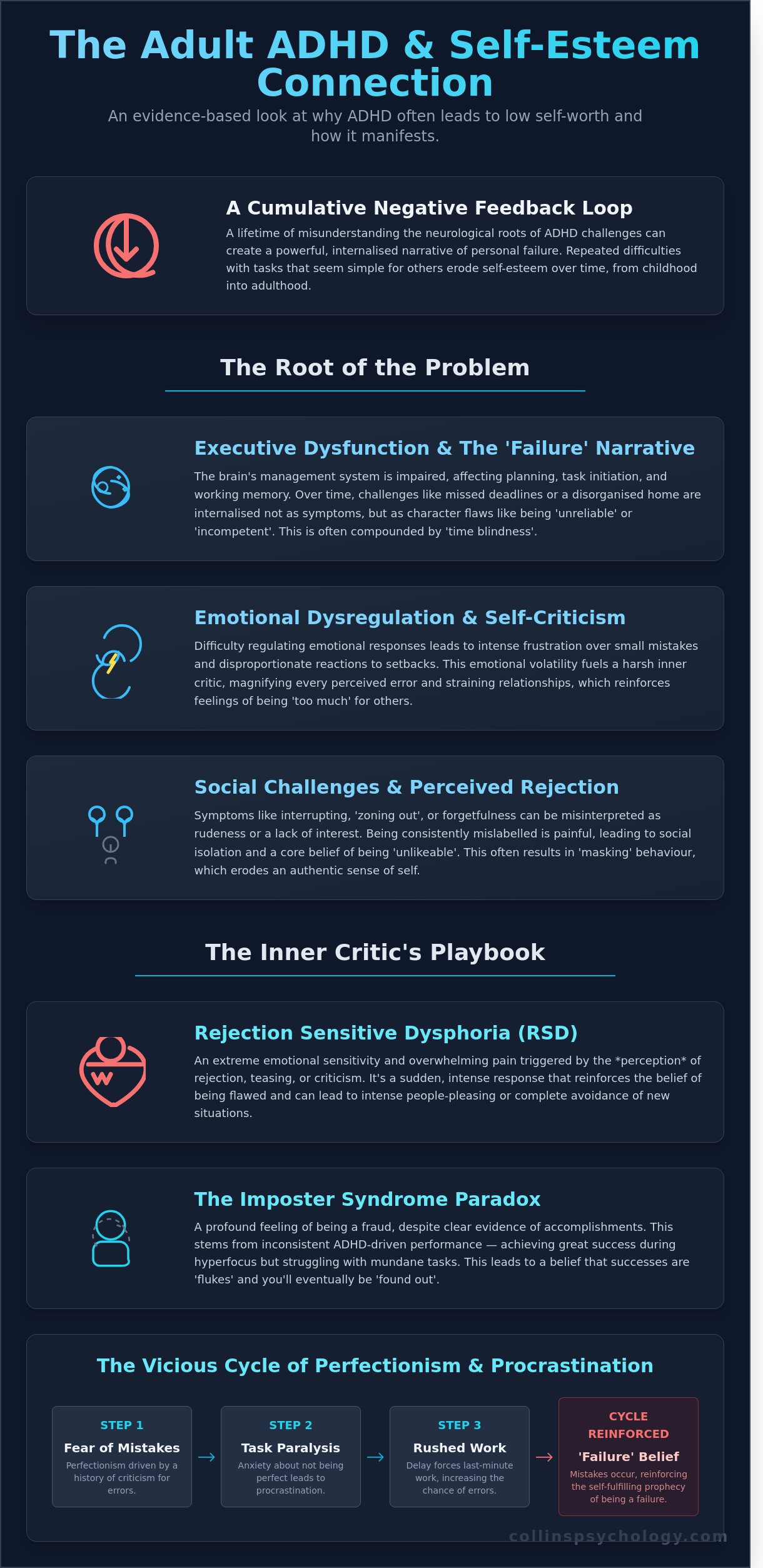
Low self-esteem is a common, but not inevitable, consequence of living with undiagnosed or unsupported ADHD. It often stems from a lifetime of misunderstanding the neurological underpinnings of your challenges, leading to a narrative of personal failure (Harpin, 2005). You may have a history of academic or professional achievements, yet internally, you struggle with feelings of inadequacy. This disconnect is the result of a cumulative negative feedback loop, where repeated difficulties with tasks that seem simple for others erode your sense of competence from childhood into adulthood.
Executive Dysfunction and the 'Failure' Narrative
Executive functions are the management system of the brain, responsible for skills like planning, initiating tasks, and working memory. When these functions are impaired, as they are in ADHD, it can lead to missed deadlines, a disorganised home, or forgotten appointments (Barkley, 2015). Over time, these outcomes can be internalised not as symptoms of a neurological condition, but as character flaws. You might start to believe you are inherently unreliable or incompetent. This is compounded by 'time blindness', a common ADHD trait that makes it difficult to perceive the passing of time, further impacting reliability and self-trust. It is crucial to understand that these are not moral failings, but challenges rooted in brain function.
Emotional Dysregulation and Self-Criticism
ADHD significantly affects the brain's ability to regulate emotional responses, a component often referred to as emotional dysregulation (Shaw et al., 2014). This can manifest as intense frustration over small mistakes or a disproportionate reaction to minor setbacks. This emotional volatility often fuels a harsh inner critic that magnifies every perceived error. These intense emotional reactions can also strain relationships with partners, friends, and colleagues, leading to a cycle of conflict and self-blame. Many adults with ADHD report feeling 'too much' for others, which further damages their self-worth.
Social Challenges and Perceived Rejection
The social landscape can be difficult to navigate with ADHD. Symptoms like interrupting conversations, 'zoning out' when someone is speaking, or being forgetful can be misinterpreted by others as rudeness, laziness, or a lack of interest. Being consistently labelled in this way is painful and can lead to social isolation and a core belief of being 'unlikeable' (Canu & Carlson, 2007). To cope, many adults with ADHD develop 'masking' behaviours, where they expend enormous energy to hide their symptoms and appear neurotypical. While this may help in the short term, it erodes an authentic sense of self and reinforces the idea that the real you is unacceptable.
The Inner Critic's Playbook: How Low Self-Esteem Manifests in the ADHD Brain
The inner critic is the internalised voice of all the negative feedback you have received over the years. For adults with ADHD, this voice is often relentless, replaying specific memories of past failures and criticisms. Living with this constant, critical internal monologue is exhausting. The goal is not to silence this voice entirely, but to understand its origins and learn to challenge its distorted messages.
Rejection Sensitive Dysphoria (RSD)
Rejection Sensitive Dysphoria, or RSD, is a term used to describe an extreme emotional sensitivity and pain triggered by the perception of being rejected, teased, or criticised (Dodson, 2016). It is different from social anxiety, which is often a state of worry about future events. RSD is a sudden, overwhelming, and painful emotional response to a present moment. It can lead to behaviours like intense people-pleasing to avoid disapproval, or avoiding new situations altogether for fear of failure. RSD powerfully reinforces the belief that you are fundamentally flawed and that rejection is inevitable.
The Imposter Syndrome Paradox
Imposter syndrome is the profound feeling of being a fraud, of having deceived others into overestimating your ability, despite clear evidence of your accomplishments. This is a common paradox for adults with ADHD who may be highly intelligent and creative. The feeling often stems from the inconsistency of ADHD-driven performance. You might achieve great success when in a state of hyperfocus, but struggle with mundane tasks, leading to a belief that your successes are flukes and you will eventually be 'found out' as incompetent.
The Vicious Cycle of Perfectionism and Procrastination
For many with ADHD, the fear of making a mistake can be paralysing. This perfectionism is often a direct response to a history of being criticised for careless errors. The anxiety of not being able to complete a task perfectly leads to procrastination, or task paralysis (Ramsay & Rostain, 2015). This delay then forces you to rush the work at the last minute, which can result in the very mistakes you were trying to avoid. This outcome reinforces the belief that you are a failure, creating a self-fulfilling prophecy. This is not laziness; it is a debilitating coping mechanism driven by fear.
Building a Stronger Self: Evidence-Based Strategies for Adults with ADHD
Rebuilding self-esteem is a skill that can be developed over time. The key is to use strategies that are designed to work with the ADHD brain, not against it. These techniques are practical tools for changing your thoughts and behaviours. It is important to start small and acknowledge your progress along the way.
Reframe Your Narrative with CBT Principles
Cognitive Behavioural Therapy (CBT) offers powerful tools for changing the stories you tell yourself. This process is known as cognitive reframing. Instead of accepting your inner critic's statements as fact, you learn to treat them as hypotheses to be questioned and challenged (Safren et al., 2017).
Separate person from behaviour
Instead of thinking "I am so forgetful," reframe it as "I forgot to do that task because my working memory is a challenge for me." This separates your identity from the symptom.
Keep an evidence log
Actively collect evidence that contradicts your negative beliefs. Keep a 'brag file' or a simple list on your phone of accomplishments, positive feedback, and moments you felt competent.
Challenge black-and-white thinking
ADHD can contribute to all-or-nothing thinking. If you make one mistake, you might feel the entire day is ruined. Practice challenging this by finding the 'grey' areas. One mistake does not negate all your efforts.
Identify and Leverage Your ADHD Strengths
A crucial step in building self-esteem is shifting your focus from fixing deficits to amplifying your inherent strengths. While ADHD presents many challenges, it is also associated with a unique set of positive traits (Sedgwick et al., 2019).
Common ADHD strengths include
Creativity, innovative problem-solving, hyperfocus on passionate interests, resilience, and high energy.
Identify your strengths
Ask yourself: When do I feel most engaged and alive? What do people compliment me on? What comes easily to me that seems hard for others?
Align your life with your strengths
Whenever possible, try to shape your work, hobbies, and social life around your natural talents. This creates more opportunities for success and builds a genuine sense of competence.
Create ADHD-Friendly Systems and Environments
Self-esteem is not built on positive affirmations alone; it grows from repeated experiences of competence. You can create these experiences by designing systems and environments that support your executive functions, rather than demanding you overcome them through willpower alone.
Externalise your brain
Use visual timers, whiteboards, phone reminders, and calendars to offload the burden on your working memory.
Set up for success
Reduce 'failure points' in your day. For example, if you always forget your keys, put a hook right by the door. If you struggle to start work, try 'body doubling', where you work quietly alongside another person.
Reduce decision fatigue
Simplify choices. Lay out your clothes the night before. Have a set routine for your mornings. The fewer decisions you have to make, the more mental energy you have for important tasks.
The Role of Therapy: How Structured Support Can Rebuild Self-Worth
While self-help strategies are valuable, the support of a well-suited therapeutic programme can significantly accelerate your progress. It is a sign of strength to seek out resources designed to help you understand your brain and build new skills.
Why Generic 'Talk Therapy' Can Fall Short
Therapists without a deep understanding of ADHD may misinterpret symptoms. For example, they might see difficulty completing homework assignments as resistance rather than a genuine executive function challenge. While exploring past experiences is important, therapy that misses the neurological component of ADHD may fail to provide the practical, skills-based strategies needed for lasting change. This can lead to frustration and the feeling that therapy 'doesn't work' for you.
The Power of Cognitive Behavioural Therapy (CBT) for ADHD
Cognitive Behavioural Therapy (CBT) is a structured, goal-oriented approach that has been shown to be highly effective for adults with ADHD (Knouse & Safren, 2010). It works by directly targeting the unhelpful thought patterns and behaviours that fuel low self-esteem. A CBT programme for ADHD does not just talk about problems; it provides a toolkit of practical skills for managing emotional regulation, improving organisation, and challenging the negative self-talk that has built up over a lifetime.
Finding the Right Support
Finding support that acknowledges the unique wiring of the ADHD brain is essential. It is important to seek out approaches that are practical, skills-based, and grounded in evidence.
At Collins Psychology, we provide online, self-paced CBT programmes designed for adults with ADHD. Our programmes do not involve one-to-one therapy; instead, they offer a flexible and accessible way to learn evidence-based strategies at your own pace. You gain access to a wealth of resources, exercises, and tools to help you understand your ADHD and build the skills needed to thrive.
Explore our evidence-based CBT programmes for Adult ADHD and start rebuilding your self-worth.
Frequently Asked Questions
Can ADHD medication help with low self-esteem?
Medication can be very effective at treating core ADHD symptoms like inattention and impulsivity. By reducing the frequency of 'failure' experiences (e.g., missed deadlines), it can indirectly improve self-esteem. However, it does not erase the years of negative self-talk, which is why therapeutic approaches like CBT are often recommended alongside medication.
How do I know if I have Rejection Sensitive Dysphoria (RSD) or just social anxiety?
Social anxiety is typically characterised by a persistent worry or fear about future social situations. RSD is more of an immediate, intense, and painful emotional reaction to a perceived slight or rejection in the present moment. While they can coexist, the key difference is the timing and nature of the emotional response.
Is it possible to develop high self-esteem later in life if I was diagnosed as an adult?
Absolutely. An adult diagnosis can be incredibly validating, as it provides a new, more accurate framework for understanding your life experiences. By learning about how your brain works and applying ADHD-friendly strategies, you can actively unlearn old, negative beliefs and build a new foundation of self-worth.
How can I explain my ADHD-related self-esteem issues to my partner or family?
It can be helpful to use analogies. Explain that ADHD is not a lack of willpower but a difference in brain wiring that affects executive functions. You could say something like, "When I forget something you told me, it's not because I don't care. It's because my brain's filing system works differently and sometimes misplaces information. It's frustrating for me too, and it makes me feel like I'm letting you down."
What's the first step I should take if I feel overwhelmed by my low self-esteem?
A great first step is to simply start noticing your self-talk without judgement. Carry a small notebook or use a notes app and for one day, just write down the critical things you say to yourself. This simple act of observation can help you see how frequent the criticism is and begin to separate yourself from that critical voice.
Can I have ADHD and high self-esteem at the same time?
Yes, it is entirely possible. High self-esteem for someone with ADHD often comes from radical acceptance of their brain, a focus on their unique strengths, and the development of effective coping strategies and systems to manage their challenges. It is not about becoming 'neurotypical', but about learning to thrive as you are.
References
Barkley, R. A. (2015). Attention-deficit hyperactivity disorder: A handbook for diagnosis and treatment (4th ed.). The Guilford Press.
Canu, W. H., & Carlson, C. L. (2007). Rejection sensitivity and social outcomes of young adult men with ADHD. Journal of Attention Disorders, 10(3), 261–275. https://doi.org/10.1177/1087054706288343
Dodson, W. (2016). New insights into rejection sensitive dysphoria. ADDitude Magazine.
Harpin, V. A. (2005). The effect of ADHD on the life of an individual, their family, and community from preschool to adult life. Archives of Disease in Childhood, 90(Suppl 1), i2–i7. https://doi.org/10.1136/adc.2004.059006
Knouse, L. E., & Safren, S. A. (2010). Current status of cognitive behavioral therapy for adult ADHD. Journal of Attention Disorders, 13(5), 523–538. https://doi.org/10.1177/1087054709356941
Ramsay, J. R., & Rostain, A. L. (2015). The adult ADHD tool kit: Using CBT to facilitate coping, mastery, and well-being. Routledge.
Safren, S. A., Sprich, S. E., Perlman, C. A., & Otto, M. W. (2017). Mastering your adult ADHD: A cognitive-behavioral treatment program, therapist guide (2nd ed.). Oxford University Press.
Sedgwick, J. A., Merwood, A., & Asherson, P. (2019). The positive aspects of attention deficit hyperactivity disorder: a qualitative investigation of successful adults with ADHD. Attention Deficit and Hyperactivity Disorders, 11(3), 241–253. https://doi.org/10.1007/s12402-018-0277-6
Shaw, P., Stringaris, A., Nigg, J., & Leibenluft, E. (2014). Emotional dysregulation and attention-deficit/hyperactivity disorder. American Journal of Psychiatry, 171(3), 276–293. https://doi.org/10.1176/appi.ajp.2013.13070966