.png)

If you are an adult with Attention Deficit Hyperactivity Disorder (ADHD), you know the challenges extend far beyond simply struggling to pay attention. You may feel a persistent sense of being overwhelmed, disorganised, or unable to manage your daily life, leading to feelings of frustration and inadequacy. This guide is designed to help you understand the 'why' behind these daily struggles with focus, memory, and motivation. We will explore the key cognitive functioning issues common in adult ADHD and introduce evidence-based strategies, like Cognitive Behavioural Therapy (CBT), that can help you work with your brain to build a more fulfilling life.
Beyond Focus: The Real Meaning of Cognitive Function in Adult ADHD
Living with ADHD often feels like a constant battle, but it is important to understand that this is not a personal failing. The difficulties you face are rooted in differences in brain function, not a lack of willpower or effort. Cognitive functions are the essential mental skills your brain uses to think, learn, remember, solve problems, and pay attention. For adults with ADHD, certain clusters of these skills, particularly those known as executive functions, present significant challenges (Barkley, 2015). We will explore these core difficulties and also look at other related cognitive issues that contribute to the complete picture of adult ADHD.
What is Executive Function? Your Brain's CEO
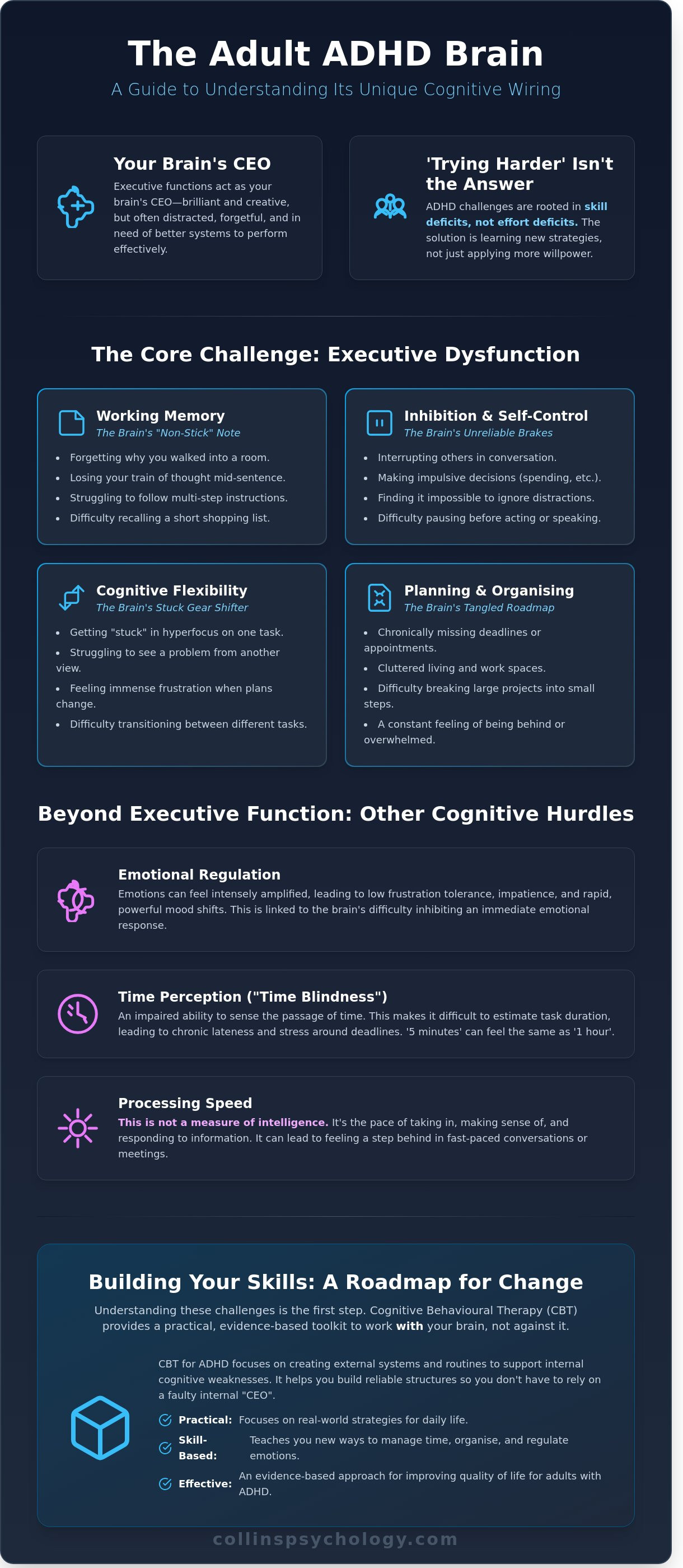
Think of your brain's executive functions as the chief executive officer (CEO) of a company. This CEO is responsible for analysing tasks, planning, organising resources, making decisions, and managing employees to execute the plan. In the brain of an adult with ADHD, this CEO is often brilliant and creative but can be easily distracted, forgetful, and overwhelmed. The CEO is not lazy; they simply need better systems and support structures to perform their job effectively.
Why 'Trying Harder' Isn't the Answer
Many adults with ADHD are told throughout their lives to 'just try harder' or 'be more disciplined'. This advice, however, misunderstands the nature of the condition. The cognitive challenges of ADHD are a result of skill deficits, not effort deficits (Brown, 2013). You cannot simply will yourself to have a better working memory any more than someone can will themselves to see clearly without glasses. The solution lies not in more effort, but in learning new strategies and building supportive systems that accommodate your brain's unique wiring.
The Core Challenge: A Deep Dive into Executive Dysfunction
Executive dysfunction is the term used to describe the range of difficulties in the skills that manage and direct our cognitive abilities. It is the most significant area of challenge for most adults with ADHD (Barkley, 2015). These skills do not work in isolation; they are an interconnected set of processes. Understanding them individually can help you pinpoint exactly where your difficulties lie.
Working Memory: The Brain's Sticky Note
Working memory is the ability to hold and mentally work with information for a short period. It is like a temporary mental notepad or sticky note. For adults with ADHD, this sticky note can feel very non-stick (Alderson et al., 2013). This can manifest as forgetting the purpose of walking into a room, losing your train of thought mid-sentence, or struggling to follow multi-step instructions at work. It impacts everything from reading comprehension to remembering a short shopping list.
Inhibition & Self-Control: The Brain's Brakes
Inhibition is the brain's braking system. It allows you to pause and think before you act or speak, control your impulses, and filter out distractions. In adult ADHD, this braking system can be less reliable. This may lead to interrupting others in conversation, making impulsive decisions, or finding it nearly impossible to ignore a notification on your phone while trying to work. This applies to both behavioural inhibition (actions) and cognitive inhibition (stray thoughts).
Cognitive Flexibility: The Brain's Gear Shifter
Cognitive flexibility is the ability to shift your thinking from one concept to another or to adapt your behaviour to changing circumstances. It is like the gear shifter in a car, allowing you to adjust to different speeds and terrains. Adults with ADHD can sometimes get 'stuck in gear'. This can look like difficulty stopping a task you are engrossed in (hyperfocus), struggling to see a problem from a different perspective, or feeling immense frustration when plans change unexpectedly.
Planning, Prioritising & Organising
This set of executive functions involves creating a mental roadmap to achieve a goal. It includes breaking down large projects into smaller steps, deciding which tasks are most important, and arranging your time and resources to get them done. Difficulties in this area are classic signs of adult ADHD, often resulting in missed deadlines, cluttered living spaces, and a constant feeling of being behind. This is a key area where practical strategies, like those taught in our CBT programme for executive function, can make a significant difference.
More Than Executive Function: Other Cognitive Hurdles in ADHD
While executive dysfunction is a primary concern, the cognitive landscape of adult ADHD is broader. Several other cognitive hurdles often accompany and interact with executive function challenges, creating a more complex picture. Acknowledging these issues is crucial for developing a holistic understanding and management plan.
Emotional Regulation: Managing the Intensity
For many, emotional regulation is one of the most challenging aspects of ADHD. This is the ability to manage and respond to an emotional experience. In ADHD, emotions can feel intensely amplified, leading to low frustration tolerance, impatience, and rapid mood shifts (Shaw et al., 2014). This is a cognitive skill, as it is linked to the brain's difficulty in inhibiting an immediate emotional response. Structured programmes can teach practical skills for emotional regulation.
Time Perception: Understanding 'Time Blindness'
'Time blindness' is a term used to describe the impaired ability to sense the passage of time, a common issue in adults with ADHD (Noreika et al., 2013). This can make it incredibly difficult to estimate how long a task will take, leading to chronic lateness or rushing to meet deadlines. For someone with this challenge, 'in five minutes' can feel almost identical to 'in an hour', making time-based planning a constant source of stress.
Processing Speed: It's Not About Intelligence
Processing speed refers to the pace at which you can take in information, make sense of it, and begin to respond. It is important to state that this has no connection to intelligence. An adult with ADHD can be highly intelligent but have slower processing speed. This might manifest as feeling a step behind in fast-paced meetings, needing extra time to formulate a response in conversation, or feeling overwhelmed in environments with a lot of simultaneous information.
Building Your Skills: How CBT Provides a Roadmap for Change
Understanding these cognitive challenges is the first step. The next is to build a toolkit of strategies to manage them. Cognitive Behavioural Therapy (CBT) is a leading evidence-based approach that is practical, skill-based, and highly effective for adult ADHD (Safren et al., 2017). It is not about 'curing' ADHD, but about providing a clear roadmap to help you work with your brain more effectively.
Developing Practical Strategies for Executive Function
CBT for ADHD focuses on creating external systems and routines to support internal cognitive weaknesses. Instead of relying on a faulty internal 'CEO', you learn to build reliable external structures. This involves practical techniques such as using planners and calendars effectively, breaking large tasks into manageable steps (task decomposition), and creating consistent daily routines that reduce the mental load of decision making.
Changing Your Relationship with Your ADHD Brain
Living with undiagnosed or poorly managed ADHD can lead to a lifetime of negative self-talk, shame, and feelings of failure. A crucial part of CBT involves identifying and challenging these unhelpful thought patterns. The therapy helps you reframe your challenges, build self-compassion, and recognise your strengths. This cognitive shift is fundamental to building confidence and achieving long-term well-being.
Where to Start Your Journey
Taking the first step towards managing your ADHD can feel empowering. If you are ready to learn practical skills to address the issues discussed in this article, our online programmes offer a structured path forward. Our CBT for Adult ADHD programme is a self-paced online course designed to give you the tools and strategies to manage executive function, emotional regulation, and other ADHD-related challenges. For any questions, please contact our team.
Frequently Asked Questions
Are cognitive functioning issues and executive dysfunction the same thing?
Not exactly. Executive dysfunction is a specific category of cognitive functioning issues. 'Cognitive functions' is a broad term for all your brain's mental processes (memory, attention, language), while 'executive functions' are the specific skills that manage and direct those other processes, like planning and self-control.
Can cognitive function in adults with ADHD improve over time?
Yes. While the underlying neurological differences of ADHD remain, the ability to manage them can improve significantly. Through targeted strategies, such as those taught in CBT, adults can build new skills and create supportive systems that compensate for cognitive weaknesses, leading to much better daily functioning.
How does medication for ADHD affect cognitive functioning?
Stimulant and non-stimulant medications are often prescribed to help manage core ADHD symptoms. They can improve neurotransmitter activity in the brain, which can lead to better focus, reduced impulsivity, and improved working memory for many individuals. They are often used alongside therapeutic approaches like CBT.
Is it possible to have executive dysfunction without having ADHD?
Yes. Executive dysfunction can be a feature of other conditions, such as brain injuries, depression, anxiety, or autism spectrum disorder. A thorough assessment from a qualified healthcare professional is needed to determine the underlying cause of these challenges.
How is CBT different from other types of therapy for ADHD?
CBT for ADHD is highly practical and skills-based. Unlike more traditional talk therapies that might explore the past, CBT is present-focused and goal-oriented. It teaches concrete strategies and tools you can apply immediately to improve your daily life, focusing on changing patterns of thinking and behaviour.
At what age can you start to see cognitive issues related to ADHD?
The core symptoms of ADHD, including those related to cognitive and executive function, typically appear in childhood, often before the age of 12. However, these challenges can become more apparent and impairing during adolescence and adulthood as academic, professional, and social demands increase.
References
Alderson, R. M., Kasper, L. J., Hudec, K. L., & Patros, C. H. G. (2013). A meta-analytic review of working memory deficits in adults with ADHD. Journal of Attention Disorders, 17(2), 107-124.
Barkley, R. A. (2015). Attention-deficit hyperactivity disorder: A handbook for diagnosis and treatment (4th ed.). The Guilford Press.
Brown, T. E. (2013). A new understanding of ADHD in children and adults: Executive function impairments. Routledge.
Noreika, V., Falter-Wagner, C. M., & Rubia, K. (2013). Timing deficits in ADHD: evidence from a review. A Neuropsychology Review, 23(3), 267-288.
Safren, S. A., Sprich, S. E., Perlman, C. A., & Otto, M. W. (2017). Mastering your adult ADHD: A cognitive-behavioral treatment program, therapist guide (2nd ed.). Oxford University Press.
Shaw, P., Stringaris, A., Nigg, J., & Leibenluft, E. (2014). Emotional dysregulation and attention-deficit/hyperactivity disorder. American Journal of Psychiatry, 171(3), 276-293.