.png)
For adults with ADHD, the experience of anxiety is often a constant, physically-felt companion that resists generic advice to 'just calm down'. The 'wired and tired' feeling, the racing heart, and the inability to settle a restless mind can make traditional mindfulness feel like an impossible task. This article explores the physiological link between ADHD and anxiety, explaining why your experience feels so physical. More importantly, it provides evidence-based, active breathing techniques specifically adapted for the neurodivergent brain, offering a practical way to manage symptoms by working with your nervous system, not against it.
The ADHD-Anxiety Loop: Why It Feels Different for Neurodivergent Adults
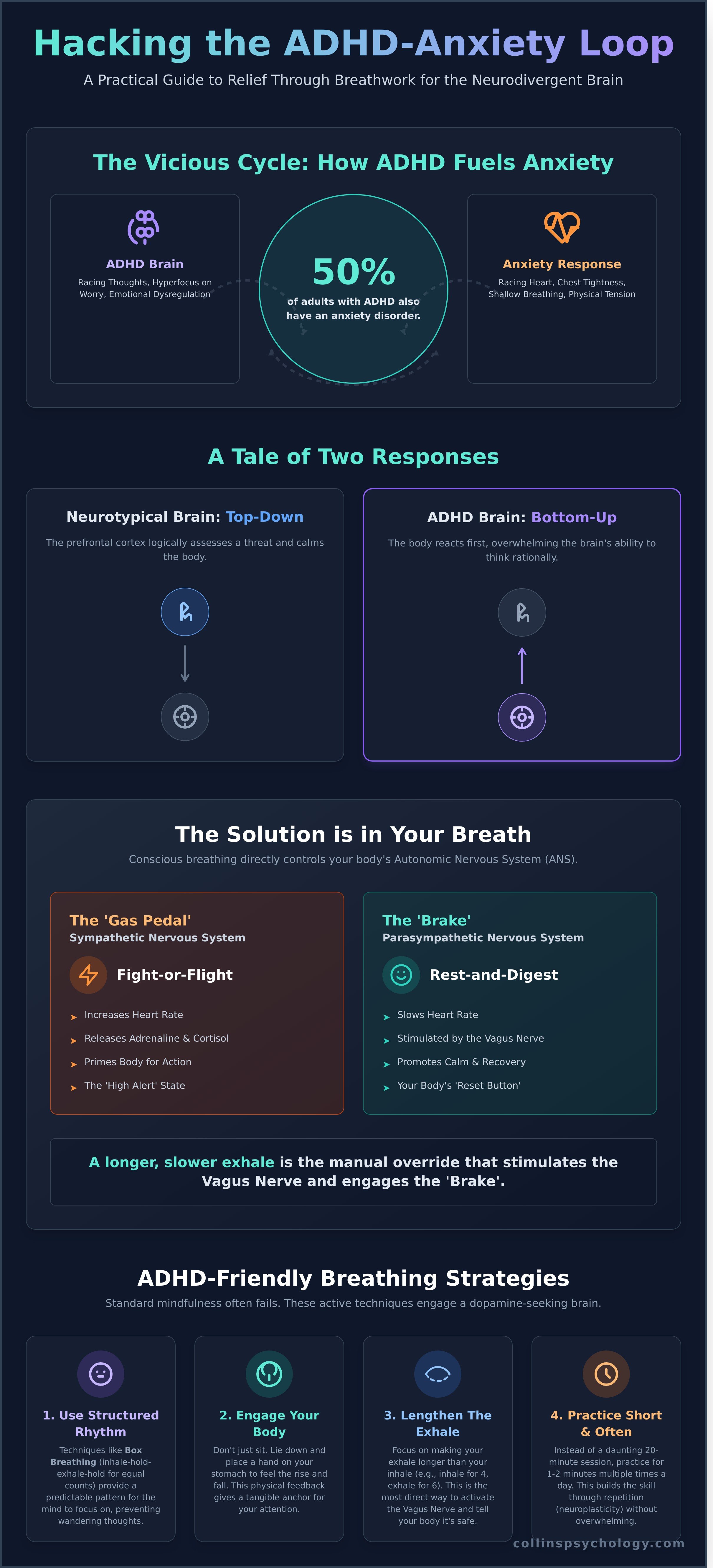
The connection between Attention-Deficit/Hyperactivity Disorder (ADHD) and anxiety is more than just a feeling of being overwhelmed; it's a well-documented clinical reality. Research indicates a high rate of comorbidity, with a significant percentage of adults with ADHD also meeting the criteria for an anxiety disorder (Katzman et al., 2017). This overlap isn't coincidental. It stems from the unique wiring of the ADHD brain, which impacts emotional regulation from the 'bottom-up' (physiological responses) as well as the 'top-down' (cognitive control). This can create a constant state of 'high alert', marked by physical symptoms like chest tightness, shallow breathing, and a racing heart, as the body’s threat response is persistently activated.
Hyperfocus on Worry: The Cognitive Component
One of the defining traits of ADHD is the brain's tendency to hyperfocus, and this can apply just as much to worry as it does to a fascinating new project. When an anxious thought appears, the ADHD brain can latch onto it, creating a relentless cycle of rumination. Challenges with working memory, a core executive function deficit in ADHD, make it difficult to hold onto calming thoughts or perspectives, allowing the anxious narrative to dominate. This is why well-intentioned advice to 'just relax' or 'think of something else' often fails; it's an instruction that runs counter to the brain's natural mode of operation.
The Physiological Toll of Unmanaged Anxiety
Living in this state of high alert has a significant physiological cost. The body is flooded with stress hormones like cortisol, which, over time, can further impair the executive functions of the prefrontal cortex—the very brain region needed to manage focus and emotional responses (Arnsten, 2009). This leads to the classic 'wired but tired' phenomenon often reported by professionals with ADHD. You feel mentally and physically exhausted, yet your nervous system is too activated to rest, creating a draining loop that impacts work, relationships, and overall well-being. Gaining control over this physiological response is the first step toward effective long-term management, which can be further developed through structured programmes like CBT for Adult ADHD.
The Science of Breath: Hacking the Vagus Nerve and Executive Function
To understand how breathwork can help, we first need to look at the body's internal control panel: the Autonomic Nervous System (ANS). The ANS operates automatically to regulate functions like heart rate and digestion, and it has two main branches. When your brain perceives a threat—whether it’s a real danger or a looping anxious thought—it activates the 'fight-or-flight' response. This is a crucial survival mechanism, but for many with ADHD and anxiety, it's overactive.
The key to manually overriding this system lies in the Vagus Nerve, the main component of the 'rest-and-digest' system. This nerve acts as your body's 'reset button'. When you deliberately slow down your breathing, particularly the exhale, you send a signal via the Vagus Nerve to your brain that you are safe. This process also helps balance carbon dioxide levels in your blood, which can calm the brain's threat detection centre, the amygdala. The result is a calmer physiological state, which allows the prefrontal cortex to come back online, improving focus and cognitive control.
Sympathetic vs. Parasympathetic States
Think of your nervous system as having a 'gas pedal' and a 'brake'. The sympathetic nervous system is the gas pedal—it revs you up for action. The parasympathetic nervous system is the brake—it slows you down and promotes recovery. Due to factors like emotional dysregulation and high sensitivity to stress, ADHD brains often feel 'stuck' with the gas pedal floored. Targeted breathing techniques act as a manual override, allowing you to consciously apply the brake and shift your body into a calmer, parasympathetic state.
Neuroplasticity and Consistent Practice
The brain is not fixed; it can change and adapt based on repeated experiences. This is known as neuroplasticity, which is the brain's ability to form new neural pathways through repeated physiological intervention. Each time you use a breathing technique to calm your nervous system, you are strengthening the neural pathway associated with self-regulation. Short, consistent sessions are more effective than infrequent long ones. Over time, this practice can rewire your baseline stress response, making it easier and more automatic to access a state of calm.
[INFOGRAPHIC: A visual representation of the Autonomic Nervous System, showing the Sympathetic (Fight-or-Flight) and Parasympathetic (Rest-and-Digest) branches, and how extended exhales activate the Vagus Nerve to shift from one state to the other.]
Why Standard Mindfulness Fails ADHD Brains (And What to Do Instead)
If you've ever tried a standard meditation app and felt more agitated than before, you are not alone. The number one objection from adults with ADHD is often, "Breathing is too boring, I can't focus." This isn't a personal failing; it's a neurobiological reality. The ADHD brain has a dopamine deficit, meaning it is constantly seeking stimulation. The instruction to 'sit still and do nothing but watch your breath' can feel like a punishment, as the lack of external stimulation can make internal noise—the racing thoughts and anxieties—even louder.
This creates a significant executive function cost. You end up using all your mental energy just to force yourself to stay still and monitor your breath, with little left over for actual relaxation. The solution is to shift from 'passive mindfulness' to 'active breathwork', which engages the body and provides enough sensory feedback to keep the ADHD brain focused.
The Barrier of Under-Stimulation
For a neurodivergent brain, quiet does not always equal calm. An under-stimulated environment can trigger restlessness and an internal search for something to focus on, which often defaults to worry. By anchoring breathwork to a physical sensation, a rhythm, or a specific count, you provide the brain with the anchor it needs to stay present. This transforms the exercise from a battle against distraction into an engaging, manageable task.
Adapting Techniques for High-Energy Brains
The key to success is adaptation. 'Fidget-friendly' breathwork strategies that involve counting or gentle movement can be highly effective. Similarly, using auditory cues like guided recordings or apps with visual pacers can offload the executive function burden of having to time and count the breaths yourself. This allows you to focus on the physiological process without getting lost in the mechanics. Structured guidance, such as that found within the Collins Psychology online programmes, can provide a clear path for building these skills.
3 ADHD-Friendly Breathing Techniques for Immediate Symptom Relief
The goal of 'active' breathing is to engage the body just enough to focus the mind. The most critical component for anxiety relief is the extended exhale. A longer exhale slows the heart rate and sends a powerful signal to the brain to activate the parasympathetic 'brake' system. Remember, the goal is not perfection. Practising for two minutes in a high-pressure workplace setting is far more beneficial than aiming for twenty minutes and giving up.
The Box Breath (The Tactical Approach)
This technique is used by emergency responders and military personnel to stay calm under pressure. The structure and counting provide the sensory feedback that an ADHD brain needs.
Step 1
Inhale slowly through your nose for a count of 4.
Step 2
Hold your breath for a count of 4.
Step 3
Exhale slowly through your mouth for a count of 4.
Step 4
Hold the breath out for a count of 4.
Repeat
Continue for 1-2 minutes. The 'hold' portion of the breath is particularly effective as it provides a distinct sensation for the brain to focus on.
Best for: High-stress moments before a presentation, a difficult conversation, or when feeling overwhelmed by a deadline.
Resonant Breathing (The Physiological Reset)
This method aims to synchronise your breathing with your heart rate, maximising Heart Rate Variability (HRV), a key indicator of nervous system balance. The ideal rhythm is around 5.5 breaths per minute.
Step 1
Inhale slowly through your nose for a count of 5.
Step 2
Exhale slowly through your mouth or nose for a count of 5.
Focus
Don't pause between breaths. Aim for a smooth, continuous rhythm. Using a visual pacer (available on many free apps or websites) can eliminate the need to count, reducing the mental load.
Best for: A daily 5-minute practice to lower your baseline stress level or as a reset during a busy day. Deeper integration of these skills is a core component of our CBT for ADHD Executive Function programme.
Physiological Sigh (The Rapid Panic Interrupter)
Based on research from Stanford University, this is the body's natural way of off-loading stress and resetting the nervous system (Huberman, 2023). It works by re-inflating collapsed air sacs (alveoli) in the lungs, allowing for a more efficient exchange of carbon dioxide and oxygen.
Step 1
Take a deep inhale through your nose.
Step 2
Without fully exhaling, take a second, sharper inhale through the nose to fully expand your lungs.
Step 3
Exhale everything in a long, slow sigh through your mouth.
Repeat
Just 1-3 cycles can produce an immediate sense of calm.
Best for: In-the-moment panic or intense anxiety. It can be done discreetly in public spaces when you feel a wave of anxiety building.
Integrating Breathwork into a Structured CBT Framework
It is important to view these breathing techniques as a powerful 'tool,' not a 'cure.' While they provide immediate physiological relief, they are most effective when integrated into a comprehensive, evidence-based framework like Cognitive Behavioural Therapy (CBT). Breathwork acts as the physiological primer that allows higher-level CBT strategies to work. It's difficult to challenge anxious thoughts when your body is in a state of fight-or-flight. By first calming your nervous system, you create the mental space needed for cognitive work. The Collins Psychology approach is to provide structured, goal-oriented online programmes that empower you with these skills.
From Physiology to Cognition
Once you use breathwork to create a 'calm window', you are better equipped to engage with CBT techniques. You can begin to notice, question, and reframe the anxious thoughts that are fuelling the cycle. This process of building emotional regulation skills requires a stable physiological foundation. The breath is the bridge that connects your physical state to your cognitive state, allowing you to move from simply managing symptoms to fundamentally changing your relationship with anxiety.
Professional Support and Next Steps
Self-help tools are an excellent starting point. However, if anxiety and ADHD symptoms are persistently impacting your quality of life, a structured programme can provide the framework and evidence-based strategies needed for lasting change.
It is important to note that Collins Psychology provides online, self-paced CBT programmes designed for adults with ADHD. These programmes offer the flexibility to learn at your own pace with a wealth of resources, exercises, and tools. We do not offer one-to-one therapy. If you are ready to move from short-term relief to long-term regulation, we invite you to explore our evidence-based CBT programmes for Adult ADHD.
Frequently Asked Questions
Is it normal for my anxiety to feel worse when I try to breathe deeply?
Yes, this can happen, especially at first. For someone used to shallow breathing, a deep breath can feel foreign and trigger a feeling of panic. It can also make you hyper-aware of your physical anxiety symptoms. Start gently with a focus on a slow, comfortable exhale rather than a huge inhale.
How long does it take for breathing exercises to actually work for ADHD?
The Physiological Sigh can have an immediate calming effect within 1-3 breaths. Techniques like Box Breathing may take a few minutes to lower your heart rate. The long-term benefit of rewiring your stress response comes from consistent, short daily practice over several weeks.
Can breathwork replace medication for anxiety?
Breathwork is a powerful self-regulation tool that can be used alongside other treatments, but it is not a replacement for prescribed medication. Any decisions about medication should always be made in consultation with your prescribing doctor or psychiatrist.
Why do I feel lightheaded when doing these exercises?
Lightheadedness is usually a sign of over-breathing or exhaling too forcefully, which can alter the CO2 balance in your bloodstream. If this happens, slow down, make your breaths shallower and more gentle, and ensure your exhale is calm, not forced.
What is the best time of day for an adult with ADHD to practice breathwork?
The best time is whenever you can be consistent. Some find it helpful to practice for 5 minutes in the morning to start the day with a calm nervous system. Others prefer using it to wind down before sleep. The key is to 'habit stack'—link your practice to an existing routine, like after brushing your teeth.
How can I remember to use these techniques when I'm actually panicking?
Practice when you are calm. By making it a regular habit, you build the 'muscle memory' for self-regulation. You can also use physical or digital reminders. Place a small sticker on your phone or computer monitor, or set a recurring, gentle alarm to prompt you to take three conscious breaths.
Are there specific apps that help with ADHD-friendly breathing?
Many apps are helpful. Look for ones that offer visual pacers or guided exercises with clear, simple instructions. Apps that allow you to set short, customisable session lengths (e.g., 2-3 minutes) are often more ADHD-friendly than those demanding long periods of meditation.
References
Arnsten, A. F. (2009). Stress signalling pathways that impair prefrontal cortex structure and function. Nature Reviews Neuroscience, 10(6), 410–422. https://doi.org/10.1038/nrn2648
Huberman, A. (2023). Toolkit for sleep, focus, and neuroplasticity. Huberman Lab. Retrieved from https://www.hubermanlab.com/toolkit
Katzman, M. A., Bilkey, T. S., Chokka, P. R., Fallu, A., & Klassen, L. J. (2017). Adult ADHD and comorbid disorders: clinical implications of a dimensional approach. BMC Psychiatry, 17(1), 302. https://doi.org/10.1186/s12888-017-1463-3