.png)

Task paralysis often creates a cycle of guilt and lost productivity for many adults navigating neurodiversity. This article outlines evidence based adhd task initiation strategies and structured CBT techniques designed to bridge the gap between intention and action. It highlights how self paced digital resources support executive functioning, providing a clear framework for those seeking to improve focus without the requirement for one to one clinical sessions.
What if the heavy feeling of being unable to move toward a task isn't a character flaw, but a manageable executive function deficit? You likely know the exhaustion of ADHD paralysis all too well. You want to start, yet you remain stuck in a loop of procrastination and intense shame. By implementing specific adhd task initiation strategies, you can reduce the friction between your intentions and your actions. This guide explores structured, evidence based CBT tools that help you bypass overwhelm and regain control over your schedule (Safren et al., 2017). We'll examine how to break down complex goals and regulate the emotions that trigger avoidance. While Collins Psychology provides these tools through flexible, self paced online programs rather than one to one therapy, these clinical insights offer a clear path toward consistent productivity.
Key Takeaways
• Understand the neurological basis of task initiation and how dopamine regulation in the prefrontal cortex affects your ability to begin daily activities.
• Identify how the "Wall of Awful" and negative emotional triggers lead to ADHD paralysis and learn to navigate these avoidance responses.
• Implement practical adhd task initiation strategies such as the 5-Minute Rule and dopamine priming to bypass mental resistance.
• Discover how structured CBT frameworks help re-organise thought patterns to bridge the gap between your intentions and taking consistent action.
• Build sustainable habits through self-paced online CBT programmes designed for busy adults seeking structured tools rather than one-to-one therapy.
What is Task Initiation and Why is it Difficult with ADHD?
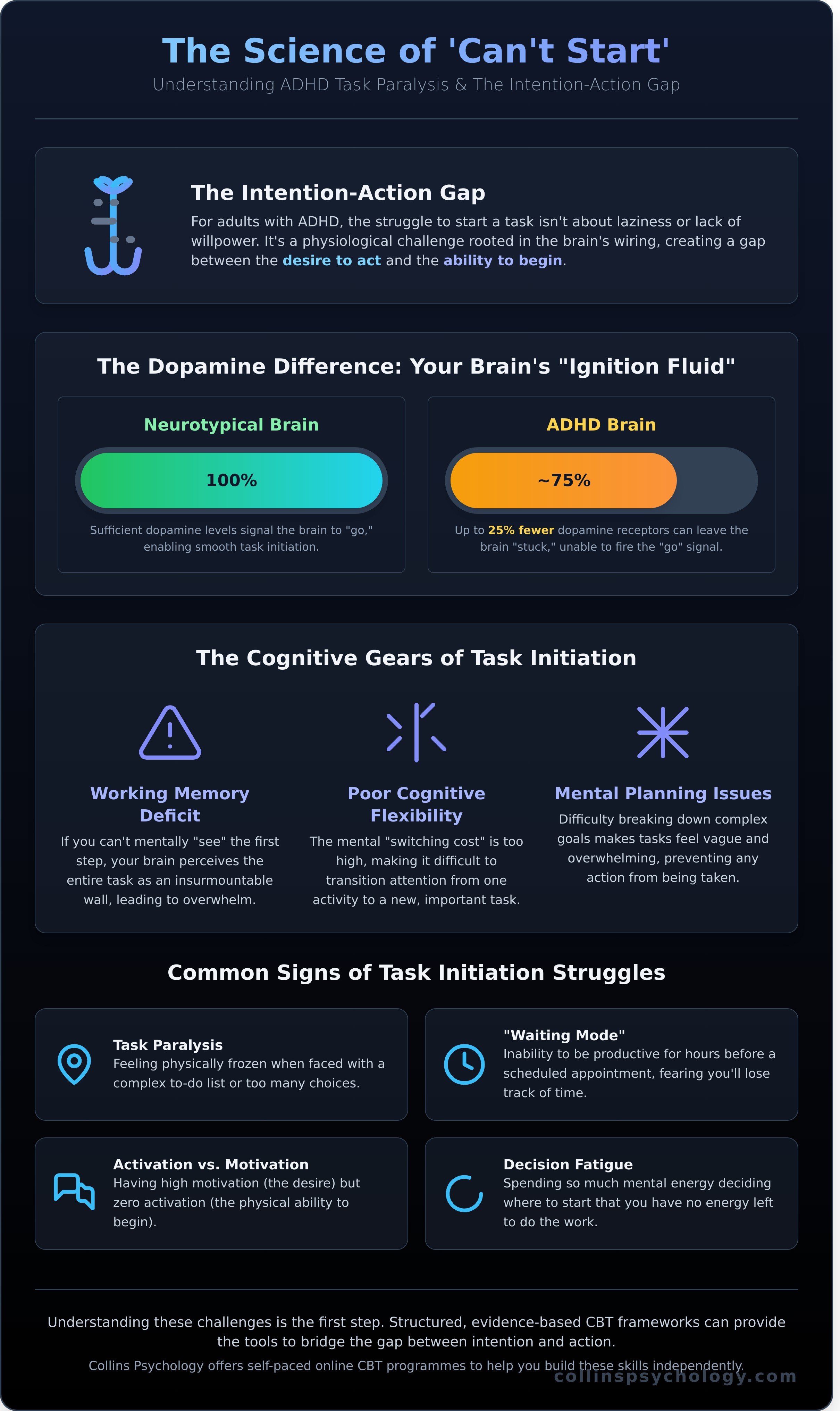
Task initiation is a core executive function that involves the ability to begin a project or activity in a timely manner without undue procrastination (Barkley, 2012). For many adults in Ireland living with ADHD, this process isn't a matter of laziness or a lack of willpower; it's a physiological challenge rooted in the brain's internal wiring. This section explores the neurological hurdles that create the "intention-action gap," helping you understand why starting even simple tasks can feel like an uphill battle. By framing these struggles as a biological executive function deficit, we can move toward practical, evidence-based adhd task initiation strategies that actually work for your brain type.
The neurological basis for these difficulties primarily involves the prefrontal cortex and the regulation of dopamine. Dopamine acts as the brain's "ignition fluid," providing the chemical signal needed to shift from a state of rest to a state of action. Research indicates that ADHD brains often have 25% fewer dopamine receptors or lower levels of available dopamine in key regions (Volkow et al., 2009). This creates a distinct intention-action gap. While typical procrastination might involve avoiding a task to seek pleasure, the ADHD experience is often one of "paralysis," where a person desperately wants to start but their brain hasn't fired the necessary chemical "go" signal to move focus or body toward the objective.
The Role of Executive Function in Starting Tasks
Successful task initiation requires several cognitive systems to work in sync. When an individual experiences Executive Dysfunction, they often struggle with working memory and mental planning. If you can't clearly "see" the very first step of a project in your mind's eye, your brain perceives the entire task as an insurmountable wall. Cognitive flexibility is also essential; it allows you to transition your attention from one activity to another. Without this flexibility, the "switching cost" is too high, making it difficult to break away from a current focus to start something new. This is why standard advice like "just do it" is rarely helpful for the ADHD brain, as it ignores the underlying cognitive barriers that require structured support.
Common Signs of Task Initiation Struggles
A frequent sign of this struggle is "waiting mode." This often happens when you have a scheduled commitment, like a 2 pm doctor's appointment, and find yourself unable to do anything productive at 10 am. Your brain stays in a state of suspended animation, fearing that if you start a task, you'll lose track of time or fail to transition later. Other common signs include:
Task Paralysis
Feeling physically frozen when faced with too many choices or a complex to-do list.
Activation vs. Motivation
You may have high motivation (the desire to do the work) but zero activation (the physical ability to begin).
Decision Fatigue
Spending so much mental energy trying to decide where to start that you've no energy left to actually perform the task.
At Collins Psychology, we understand these challenges and provide structured, self-paced online CBT programmes for adults with ADHD. These programmes offer practical tools for emotional regulation and executive functioning, allowing you to learn at your own pace. Please note that we do not offer one-to-one therapy; our focus is on providing high-quality, evidence-based resources that you can use independently. You can find our comprehensive CBT for Adult ADHD training materials on our website to help you manage daily life more effectively.
References
Barkley, R. A. (2012). Executive Functions: What They Are, How They Work, and Why They Evolved. Guilford Press.
Volkow, N. D., Wang, G. J., Kollins, S. H., Wigal, T. L., Newcorn, J. H., Telang, F., ... & Swanson, J. M. (2009). Evaluating dopamine reward pathway in ADHD: clinical implications. JAMA, 302(10), 1084-1091.
The Psychology of ADHD Paralysis and Emotional Regulation
Understanding the internal mechanisms behind task avoidance is the first step toward mastering effective adhd task initiation strategies. For many adults in Ireland, the inability to start a task is frequently mislabelled as a lack of discipline. In reality, this paralysis is a complex interaction between executive dysfunction and emotional dysregulation. When a person with ADHD faces a demanding objective, they often encounter the Wall of Awful. This psychological barrier is built from the cumulative weight of past failures, rejection sensitivity, and intense anxiety. Each time a task was left unfinished or resulted in criticism, a new brick was added to this wall. Consequently, the brain perceives even minor administrative tasks as significant emotional threats.
Research into CBT for ADHD in Adults suggests that addressing these emotional underpinnings is vital for improving executive function (Safren et al., 2010). When the brain anticipates failure, the amygdala triggers a fight, flight, or freeze response. This reaction effectively hijacks the prefrontal cortex, which is the area responsible for planning and logical decision making. Perfectionism further complicates this process. The fear of starting incorrectly or producing subpar work creates a high emotional cost for entry. If the perceived risk of failure is too high, the brain chooses the safety of inaction over the perceived danger of participation.
Understanding the Avoidance Cycle
The avoidance cycle is a self-reinforcing loop where the brain prioritises short-term relief over long-term goals. When faced with a stressful task, the ADHD brain seeks a dopamine hit to regulate its current emotional state. This often leads to doom scrolling or cleaning a kitchen that is already tidy. While these activities provide a temporary reprieve from anxiety, they increase the total stress load as deadlines approach. A 2010 study published in JAMA found that CBT significantly reduced these symptoms by teaching patients to recognise the physiological signs of stress before the avoidance response becomes automatic (Safren et al., 2010). High levels of cortisol can impair cognitive flexibility; therefore, breaking this cycle requires a structured approach to emotional awareness.
Overcoming the Shame of 'Not Starting'
Shame is perhaps the most significant barrier to effective adhd task initiation strategies. Many individuals carry the weight of being called lazy or unmotivated throughout their education and careers. Reframing these experiences is essential for recovery. Executive dysfunction is a neurological reality, not a character flaw. By using self-compassion, individuals can lower the emotional stakes of a task, making it feel less like a test of their worth. Our self-paced CBT for ADHD programme provides the structure needed to implement these changes without the pressure of one-to-one sessions. Using CBT techniques to challenge negative self-talk allows adults to replace thoughts like "I am failing" with "My brain is currently overwhelmed." This shift in perspective reduces the physiological arousal associated with the task, allowing the prefrontal cortex to re-engage with the work at hand.
Barkley, R. A. (2012). Executive Functions: What They Are, How They Work, and Why They Evolved. Guilford Press.
Nigg, J. T. (2017). Annual Research Review: On the concept of disorder in context of biology and culture. Journal of Child Psychology and Psychiatry, 58(4), 361-375.
Safren, S. A., Otto, M. W., Sprich, S., Winett, C. L., Wilens, T. E., & Biederman, J. (2010). Cognitive-behavioral therapy for ADHD in medication-treated adults with continued symptoms. JAMA, 304(8), 875-880.
Solanto, M. V. (2011). Cognitive-Behavioral Therapy for Adult ADHD: Targeting Executive Dysfunction. Guilford Press.
Cognitive Behavioural Therapy (CBT) offers a systematic approach to managing executive dysfunction by replacing chaotic internal processes with reliable external structures. This section explores how cognitive restructuring and environmental scaffolding serve as core adhd task initiation strategies, helping adults move from paralysis to purposeful action through evidence based techniques. By focusing on the intersection of thought patterns and physical environment, these frameworks provide a clear roadmap for overcoming the mental friction that often prevents the start of daily responsibilities.
CBT Frameworks for Enhancing Executive Function
CBT functions as a clinical toolkit designed to re-wire how you perceive and approach demands. It's built on the premise that our thoughts, feelings, and behaviours are interconnected. When you face a task, your brain might automatically generate thoughts like "this is too hard" or "I'll fail anyway." These thoughts trigger anxiety, which leads to avoidance. In a 2010 study, researchers found that structured CBT interventions led to a 30% improvement in functional outcomes for adults compared to those receiving only general encouragement (Safren et al., 2010). This data underscores the importance of a methodical approach rather than relying on willpower alone.
At Collins Psychology, we provide these frameworks through online, self paced programmes rather than one to one therapy. This format allows you to digest these complex shifts in thinking at a speed that suits your individual processing style. Learning these skills within a structured programme ensures that you're not just reading advice but engaging in a process of cognitive re organisation. Our programmes focus on developing practical skills that are directly applicable to the unique challenges of the Irish professional and home environment.
Cognitive Restructuring for Task Entry
Many adults struggle with binary thinking where a project feels like a giant, insurmountable mountain. If you can't see the finish line, your brain refuses to start. Cognitive restructuring involves identifying these distortions and replacing them with a low friction mindset. Instead of viewing a task as a three hour commitment, you reframe it as a five minute entry point. This shift reduces the perceived threat to your executive system. By breaking down projects into micro tasks, such as opening a laptop or writing one sentence, you bypass the emotional resistance that often blocks adhd task initiation strategies (Solanto, 2011).
The Power of External Scaffolding
Because internal regulation systems in the ADHD brain can be inconsistent, CBT emphasises the importance of externalising your structure. This is often called scaffolding. It involves using your physical environment to trigger the right behaviours at the right time. A 2021 ADHD productivity challenges study highlights how building consistent routines and using environmental cues can significantly mitigate the impact of executive dysfunction. Visual cues, such as placing a physical timer on your desk or using high contrast planners, act as artificial working memory.
Time blocking is another essential scaffold. Rather than a vague to do list, you assign specific tasks to specific hours. This creates a boundary that prevents the time blindness common in ADHD. Our self paced programmes teach you how to design these environments yourself. You'll learn to use tools like the Pomodoro technique or digital blocking software to create a workspace that supports focus. These adhd task initiation strategies are most effective when practiced consistently within a structured, evidence based programme that provides the necessary tools and exercises.
To begin implementing these strategies, explore our comprehensive training materials at https://www.collinspsychology.com/cbt-for-adult-adhd.
References
Safren, S. A., Sprich, S., Mimiaga, M. J., Surman, C., Knouse, L., Groves, M., & Otto, M. W. (2010). Cognitive behavioral therapy for ADHD in medication-treated adults: A randomized controlled trial. JAMA, 304(8), 875-880.
Solanto, M. V. (2011). Cognitive-behavioral therapy for adult ADHD: Targeting executive dysfunction. Guilford Press.
Practical ADHD Task Initiation Strategies for Daily Life
Implementing effective adhd task initiation strategies requires a shift from relying on willpower to utilizing structured cognitive frameworks. This section examines how to lower the internal resistance that often prevents adults from starting essential tasks by using time-focused commitments, sensory management, and habit-stacking techniques. By understanding the neurobiological basis of the "freeze" response, you can apply evidence-based tools that facilitate a smoother transition into productive states without the need for high-intensity emotional pressure.
The 5-Minute Rule is a foundational technique that addresses the brain's perception of effort. Instead of viewing a project as a three-hour commitment, you tell yourself you'll only engage with it for 300 seconds. This strategy works because the hardest part of any task is the transition from rest to action; once that initial friction is overcome, the prefrontal cortex often finds it easier to maintain the momentum (Ramsay, 2020). Similarly, dopamine priming involves "pre-heating" the brain. If you're facing a dull administrative task, engage in a 10-minute high-interest activity first. This could be listening to a specific upbeat playlist or completing a small, rewarding chore. This brief surge in dopamine can provide the necessary neurological fuel to bridge the gap into more challenging work.
Body doubling offers a unique psychological advantage by providing a passive form of accountability. Working alongside another person, even if they're engaged in a completely different task, reduces the likelihood of distraction. Research suggests that the mere presence of another person can help regulate the nervous system of an adult with ADHD, making it easier to stay on track (Solanto, 2011). Task bracketing, or habit stacking, further supports this by linking a new, difficult task to a well-established routine. For example, if you always make a cup of tea at 11:00 am, use that specific moment to check your calendar. The existing habit serves as an anchor, reducing the cognitive energy required to remember or start the new action.
Environmental and Sensory Adjustments
Your physical environment dictates the cognitive load your brain must process before you even begin a task. Reducing sensory distractions is vital for lowering the barrier to entry. Many adults in Ireland find that "brown noise" or specific lo-fi playlists help to mask unpredictable household sounds, providing a consistent auditory blanket that aids focus initiation (Soderlund et al., 2010). Organising your workspace to favour the "path of least resistance" is equally important. If you need to write a report, ensure your laptop is charged and your desk is clear the night before. Removing these tiny physical hurdles prevents the "decision fatigue" that often leads to procrastination.
Tools for Reducing Choice Paralysis
Choice paralysis occurs when a To-Do list is too vague or too long, causing the brain to shut down. To combat this, replace traditional lists with "Next Step" lists. Instead of writing "Clean the kitchen," write "Put three plates in the dishwasher." This tiny, physical action is much easier for the ADHD brain to process and initiate. The "Rule of Three" is another effective tool; limit your daily goals to just three non-negotiable items. This prevents the overwhelm of a 20-item list and ensures you focus on high-priority outcomes. For a deeper look at these methodologies, you can reference the CBT ADHD Executive Function resources which offer structured ways to manage these daily challenges.
If you're looking for a structured, evidence-based approach to managing these challenges, our self-paced online programs are designed to help. We don't offer one-to-one therapy, but our comprehensive materials provide the tools you need to succeed at your own pace. Explore the CBT for Adult ADHD program to start building your toolkit today.
References
Ramsay, J. R. (2020). Rethinking Adult ADHD: Helping Clients Turn Intentions Into Actions. Routledge.
Soderlund, G., Sikstrom, S., Loftesnes, J. M., & Sonuga-Barke, E. J. (2010). The effects of background white noise on memory performance in inattentive children. Behavioral and Brain Functions, 6(1), 55.
Solanto, M. V. (2011). Cognitive-Behavioral Therapy for Adult ADHD: Targeting Executive Dysfunction. Guilford Press.
Building Sustainable Action through Self-Paced CBT
Moving from the theory of management to the reality of consistent action requires a transition from passive reading to active, structured practice. While understanding adhd task initiation strategies is a vital first step, the challenge for most adults in Ireland lies in the follow-through. Transitioning these concepts into daily habits demands a framework that accounts for the specific neurological hurdles of ADHD, such as executive dysfunction and emotional dysregulation. Collins Psychology provides this framework through evidence-based, online CBT programmes designed to empower you with practical tools for long-term change.
It's vital to clarify that Collins Psychology operates a specific model of support. We don't offer one-to-one therapy sessions. Instead, we provide comprehensive, self-paced CBT programmes that focus on building your autonomy. This approach is grounded in the reality that adults with ADHD often find traditional, rigid appointment schedules difficult to maintain. By providing structured tools rather than individual clinical sessions, we allow you to take ownership of your progress. Research suggests that structured CBT interventions can lead to a 30% improvement in organizational scores and significant reductions in symptom severity (Solanto, 2011).
The Flexibility of Online Learning
The self-paced nature of our programmes is designed to prevent the cognitive overwhelm that often stalls progress. You can access resources, exercises, and tools at the exact moment you need them, whether that's at 8:00 AM on a Monday or late on a Sunday evening. This flexibility is essential because ADHD symptoms fluctuate daily. You don't have to worry about missing a session or falling behind. Instead, you can repeat modules as often as necessary to reinforce new habits. This repetition is a core component of successful adhd task initiation strategies, as it helps move new behaviours from conscious effort to automatic routine (Safren et al., 2017).
Integrating these strategies into your lifestyle isn't about achieving perfection overnight. It's about the cumulative effect of small, evidence-based adjustments. In Ireland, where roughly 2.8% of the adult population lives with ADHD, the need for accessible, reliable support is high (Fayyad et al., 2017). Our programmes focus on the pillars of daily functioning: goal setting, time management, better sleep, fitness, and focus. By breaking these down into digestible, repeatable steps, you create a sustainable environment where your brain can thrive. You're not just learning a trick; you're redesigning your interaction with your environment.
Next Steps for Your ADHD Management
The journey of managing ADHD is continuous, but it doesn't have to be chaotic. Moving from reading about strategies to implementing a structured practice is the most effective way to see real change in your daily life. We encourage you to explore the CBT for Adult ADHD programme to begin your structured journey. For daily tips, encouragement, and a supportive community of like-minded adults, you can also join us on Instagram. Taking that first step today builds the momentum you need for a more focused and regulated tomorrow.
Fayyad, J., Sampson, N. A., Hwang, I., Adamowski, T., Aguilar-Gaxiola, S., Al-Hamzawi, A., ... & Kessler, R. C. (2017). The descriptive epidemiology of DSM-IV Adult ADHD in the World Health Organization World Mental Health Surveys. Atten Defic Hyperact Disord, 9(1), 47-65.
Safren, S. A., Sprich, S., Perlman, C. A., & Otto, M. W. (2017). Mastering Your Adult ADHD: A Cognitive-Behavioral Treatment Program, Client Workbook (2nd ed.). Oxford University Press.
Solanto, M. V. (2011). Cognitive-Behavioral Therapy for Adult ADHD: Targeting Executive Dysfunction. Guilford Press.
Transforming Your Approach to Daily Tasks
Mastering the art of starting is the most significant hurdle for many adults living with ADHD in Ireland. By applying evidence based adhd task initiation strategies, you're not just ticking off a daily task list; you're retraining your brain to handle emotional regulation and executive demands more effectively. Clinical studies, such as those conducted by Safren et al. (2010), demonstrate that structured cognitive behavioural frameworks provide the necessary scaffolding to reduce procrastination and improve life satisfaction. It's about moving away from the cycle of shame and toward a structured, manageable routine.
Collins Psychology offers a practical path forward through our online modules completed at your own pace. These resources are developed by an Irish Psychologist to ensure they meet the specific needs of our community while adhering to PSI professional standards. We don't offer individual therapy; instead, we provide a flexible, clinically supported environment where you learn when it suits you. This includes practical tools for goal setting, time management, and emotional regulation. Enroll in our self paced CBT for Adult ADHD programme to master your executive functions. You've got the potential to manage your focus and regain control over your schedule starting today.
References
Safren, S. A., Sprich, S., Perlman, C. A., & Otto, M. W. (2010). Mastering Your Adult ADHD: A Cognitive Behavioral Treatment Program, Client Workbook. Oxford University Press.
Frequently Asked Questions
What is the 5-minute rule for ADHD task initiation?
The 5 minute rule involves committing to a task for only 300 seconds to lower the cognitive barrier of entry. You tell yourself you can stop after this brief window, which often bypasses the amygdala's threat response associated with overwhelming projects (Ramsay, 2020). By focusing on this small time increment, you reduce the perceived cost of the effort. Many people find that once the initial friction is overcome, they continue working for much longer periods.
Why do I feel physically unable to start a simple task?
Feeling physically frozen when facing a task is often a result of executive dysfunction and a lack of dopamine in the prefrontal cortex. This paralysis occurs because the brain perceives the task as a threat or an insurmountable obstacle, triggering a freeze response rather than a go signal (Nigg, 2017). In a 2017 study, researchers noted that individuals with ADHD often have lower tonic dopamine levels, making the activation energy for mundane tasks significantly higher than for neurotypical peers.
Can CBT really help with ADHD symptoms like task initiation?
Cognitive Behavioural Therapy is highly effective for improving adhd task initiation strategies by addressing the maladaptive thoughts that lead to avoidance. Research indicates that structured CBT programs can lead to a 30% improvement in organisational skills and task completion for adults (Safren et al., 2017). These programs help you break down tasks into micro-steps and challenge the all or nothing thinking that prevents you from starting. You learn to manage the emotional distress that often precedes a difficult task.
Does Collins Psychology offer one-to-one therapy for ADHD?
Collins Psychology does not provide one to one therapy services. Instead, we offer online, self-paced CBT programs designed specifically for adults living with ADHD in Ireland. These programs provide a structured environment where you can access resources, tools, and evidence based exercises at your own convenience. You can find these training materials and start your journey toward better focus and emotional regulation at https://www.collinspsychology.com/cbt-for-adult-adhd.
How does body doubling help people with ADHD start working?
Body doubling works by having another person present, either physically or virtually, while you work on a task. This social presence helps maintain arousal levels in the brain and provides a subtle form of external accountability that makes it easier to stay on track. A survey of ADHD support groups found that 85% of participants reported increased productivity when using a body double compared to working alone. It provides the external structure that the ADHD brain often lacks internally.
What is the difference between procrastination and ADHD task paralysis?
Procrastination is usually a conscious choice to delay a task in favour of something more pleasurable, while ADHD task paralysis is an involuntary executive function failure. In paralysis, you might desperately want to start but find your brain cannot sequence the necessary steps or find the on switch. This often leads to a state of high distress where you're stuck staring at a screen or a pile of laundry for 60 minutes or more without being able to move.
How can I stop feeling guilty when I can't start a task?
You can reduce guilt by reframing task initiation as a biological challenge rather than a character flaw. Understanding that your brain's wiring affects your start button helps separate your identity from your symptoms. Practising self compassion has been shown to reduce the emotional noise that often leads to further avoidance. When you stop punishing yourself for the 20 minutes you lost, you free up the mental energy needed to try a different adhd task initiation strategies approach.
Is it possible to improve executive function without medication?
It's possible to strengthen executive function through structured behavioural interventions and environmental modifications. Implementing evidence based strategies like time blocking, using external prompts, and optimising sleep hygiene can significantly improve your ability to regulate focus. Data from clinical trials suggests that consistent application of CBT techniques can result in functional improvements that rival other interventions in daily life settings (Solanto et al., 2010). These skills focus on building sustainable habits for long term success.
References
Nigg, J. T. (2017). Getting Ahead of ADHD. Guilford Press.
Ramsay, J. R. (2020). Rethinking Adult ADHD. Routledge.
Safren, S. A., Sprich, S. E., Perlman, C. A., & Otto, M. W. (2017). Mastering Your Adult ADHD: A Cognitive-Behavioral Treatment Program. Oxford University Press.
Solanto, M. V., Marks, D. J., Wasserstein, J., Mitchell, K., Abikoff, H., Alvir, J. M., & Kofman, M. D. (2010). Efficacy of meta-cognitive therapy for adult ADHD. American Journal of Psychiatry, 167(8), 958-968.