.png)

Struggling with deadlines, constantly running late, and feeling like time slips through your fingers? You are not alone. For many adults with ADHD, this experience, known as time blindness, is a daily challenge that can lead to significant stress and self-criticism. This guide moves beyond simple tips to explore the cognitive science behind time blindness. It offers structured, evidence-based Cognitive Behavioural Therapy (CBT) strategies designed to help you externalise your sense of time, build reliable systems, and regain control over your schedule, all within a framework that aligns with professional psychological standards in Ireland.
Understanding the Reality of Time Blindness in Adult ADHD
Time blindness is not a character flaw or a sign of laziness; it is a core difficulty with temporal processing and awareness directly linked to the executive function challenges inherent in ADHD. It represents a genuine deficit in the brain's ability to perceive, manage, and sequence time. For many, this manifests as a constant feeling of being out of sync with the world, leading to shame, anxiety, and the internalisation of unfair labels. Understanding this challenge from a psychological perspective is the first step toward managing it effectively, using approaches that are consistent with the guidelines of bodies such as the Psychological Society of Ireland (PSI).
The Three Dimensions of Time Awareness
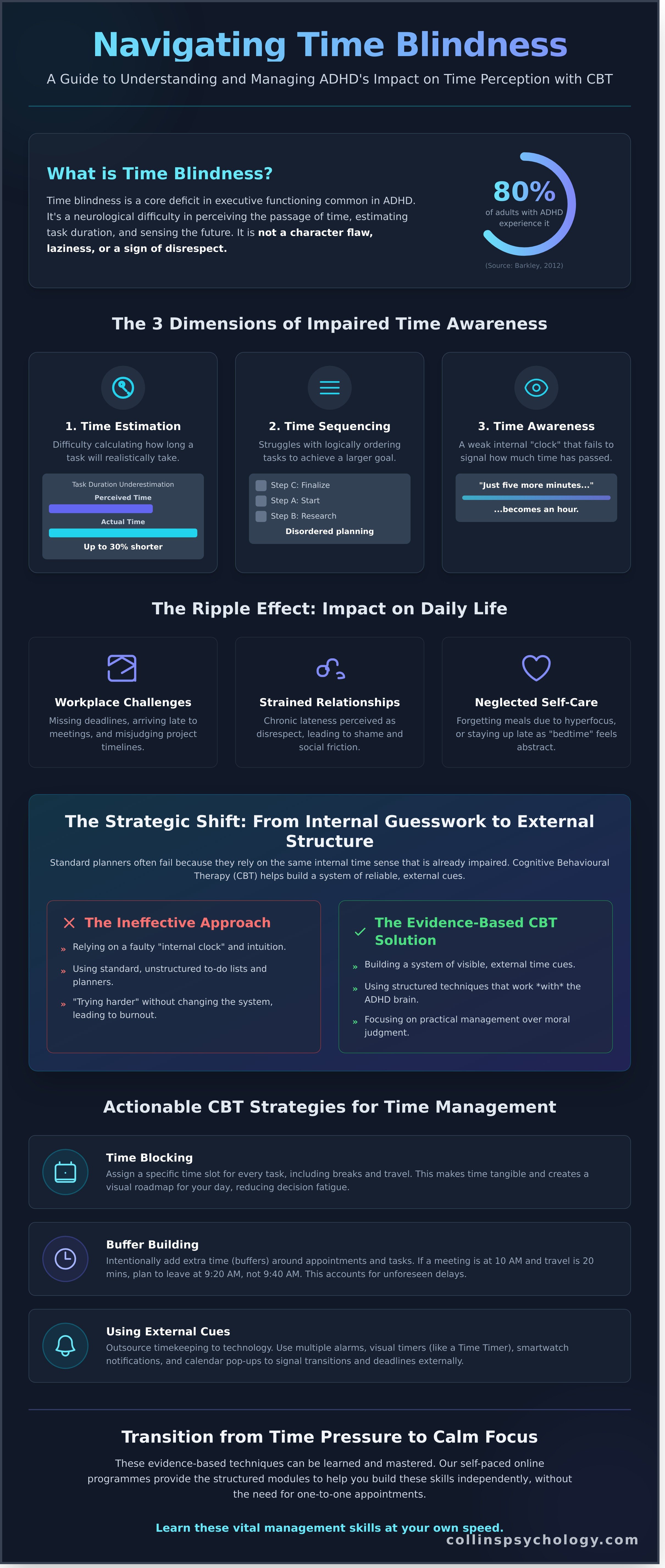
The struggle with time in ADHD can be broken down into three distinct dimensions:
Time estimation
Difficulty in accurately predicting how long a task will realistically take to complete. An activity thought to take ten minutes might easily consume an hour.
Time sequencing
Challenges in planning the order in which tasks should be completed for maximum efficiency. This can lead to starting projects in an illogical order or feeling overwhelmed by where to begin.
Time awareness
A diminished internal sense of the passage of time. Without an external prompt, minutes and hours can blend, making it difficult to feel time moving forward.
Impact on Daily Adult Life
When these dimensions of time awareness are impaired, the consequences ripple through every aspect of adult life:
Workplace challenges
Chronic lateness, missed deadlines, and underestimating project timelines can create friction with colleagues and management.
Personal life
Forgetting appointments, arriving late for social events, or missing important family obligations can strain relationships and lead to feelings of guilt.
Self-care
Basic routines can be disrupted, such as forgetting to eat meals at regular intervals, staying up far too late, or not making time for exercise.
The Science of Temporal Processing and Executive Function
The brain's ability to manage time is a complex process primarily handled by the prefrontal cortex, the area responsible for executive functions. For individuals with ADHD, differences in this brain region and its neurochemical pathways can significantly impact the internal clock. The neurotransmitter dopamine, which plays a key role in focus and reward, is also crucial for time perception. Fluctuating dopamine levels can distort the brain's ability to mark time accurately (Barkley, 1997). This often creates a "Now vs. Not Now" binary, where the brain struggles to process time in a linear fashion, viewing tasks as either happening immediately or at some undefined point in the future. Research indicates that adults with ADHD often underestimate time intervals by up to 30% compared to neurotypical peers (Noreika et al., 2013).
Executive Functioning and the Internal Clock
Executive function is often described as the "CEO of the brain," responsible for planning, organising, and executing tasks. Key components that affect time management include:
Working memory
This is the mental workspace we use to hold information temporarily. Deficits in working memory make it hard to keep track of time while engaged in a task, as the sense of passing minutes is not held "online."
Emotional regulation
Strong emotions can further distort time perception. For example, anxiety about a deadline can make time feel like it is moving faster, while boredom can make it feel slower, making objective time management even harder.
Why "Trying Harder" Does Not Work
Telling someone with time blindness to simply "try harder" or "be more motivated" is like asking someone with poor eyesight to see more clearly by squinting. The difficulty is not one of willpower but of cognitive processing. It is recognised as a legitimate diagnostic feature of ADHD, rooted in neurobiology (American Psychiatric Association, 2022). Consequently, lasting change comes not from sheer effort but from implementing external structures and strategies that compensate for the internal deficit.
Why Standard Planners Fail: Internal vs External Time Cues
Many adults with ADHD have a "planner graveyard," a collection of abandoned diaries, apps, and scheduling tools. These often fail because they are designed for neurotypical brains that possess a reliable internal sense of time. They are meant to organise time, not create an awareness of it. The key to success is understanding the difference between internal time sensing and external time measuring and building a system that relies entirely on the latter. This involves "externalising" the executive function of timekeeping, moving it from a weak internal sense to a robust, visible external environment.
The Difference Between Sensing and Measuring
Internal cues
This is the intuitive, gut feeling of how much time has passed. It is the sense that "it has been about ten minutes" since you started a task. For the ADHD brain, this sense is often unreliable.
External cues
These are concrete, sensory prompts that measure time objectively. A ticking clock, a timer alarm, or a calendar notification are all external cues. The ADHD brain requires these cues to be "loud," frequent, and visual to be effective.
Building a Reliable External Environment
The goal is to create a world where you do not need to feel time because you can see and hear it everywhere.
Use analog clocks
Unlike digital clocks that only show the present moment, analog clocks provide a visual representation of time passing and how much is left in an hour.
Strategic placement
Place clocks in every room you use, including the bathroom. This prevents you from losing track of time when moving between spaces.
Reduce friction
Make time visible and unavoidable. Use timers for everything from showering and cooking to focused work sessions (e.g., the Pomodoro Technique).
Evidence-Based CBT Strategies to Manage Time Blindness
Cognitive Behavioural Therapy (CBT) is a highly effective, evidence-based approach for managing the daily challenges of adult ADHD (Safren et al., 2017). It provides a structured framework for changing unhelpful thought patterns and behaviours related to time. Instead of relying on a faulty internal clock, CBT helps you build a reliable external system. Key techniques include:
Time-Blocking
Scheduling your entire day in visual blocks, assigning a specific task to each period.
Buffer-Building
Intentionally scheduling empty time between appointments and tasks to account for underestimation and transitions.
Task-Splitting
Breaking large, overwhelming projects into small, concrete, and time-limited steps.
Cognitive Reframing of Time
A core component of CBT is addressing the thoughts that drive unhelpful behaviours. This involves:
Identifying negative thought patterns
Recognising and challenging thoughts like "I have plenty of time" or "I work better under pressure."
Replacing "all-or-nothing" thinking
Moving away from the idea that if you are five minutes late, the whole day is ruined. Instead, you learn to adapt and recover from minor schedule slips.
Practising self-compassion
Acknowledging that time management is a genuine difficulty and treating yourself with understanding, not criticism, when things do not go perfectly to plan.
Practical CBT Exercises for Daily Use
CBT is about action. These exercises help translate theory into practice:
The "Time Audit"
For one week, write down how long you think a task will take. Then, time yourself doing it. This helps recalibrate your time estimation skills by providing real-world data.
Setting "Implementation Intentions"
Use an "If/Then" structure to plan your actions. For example, "If it is 10 AM, then I will stop what I am doing and start writing the report." This creates a strong link between a time cue and a desired behaviour. You can use online modules for executive function to systematically develop these habits.
Goal Setting and Focus
Time blindness can make long-term goals feel impossibly distant.
Break it down
Translate yearly or monthly goals into specific, actionable tasks you can do today or this week.
Use structure
The process of structured goal setting is crucial for those with ADHD, as it provides a clear roadmap and prevents overwhelm.
Avoid the hyperfocus trap
While hyperfocus can be a strength, it often leads to losing hours. Use external timers to remind you to take breaks and switch tasks, ensuring important priorities are not neglected.
Implementing Structure through Online CBT Modules
Managing ADHD effectively requires consistent application of these strategies. Our model at Collins Psychology is built around providing online, self-paced CBT programmes that empower you to learn these skills flexibly. We do not offer one-to-one appointments; instead, we provide a comprehensive, structured curriculum that you can work through at a pace that suits you. This approach focuses on building robust skills in emotional regulation and executive function, which are the foundations of better time management.
The Flexibility of Self-Paced Learning
Online learning is uniquely suited to the ADHD brain.
No scheduling pressure
You do not need to travel to a clinic or commit to a fixed appointment time each week.
24/7 access
All resources, exercises, and tools are available whenever you feel most focused and ready to learn.
Varied stimulation
The combination of videos, worksheets, and practical exercises keeps the learning process engaging and helps maintain motivation.
Starting Your Journey Today
You can learn to work with your brain, not against it. By implementing a structured, external system, you can reduce the constant stress of lateness and missed deadlines. Structure is the bridge that allows you to move from feeling chaotic to feeling in control.
Explore our structured CBT programmes for Adult ADHD and regain control of your time
Frequently Asked Questions (FAQs)
What exactly is time blindness in adults with ADHD?
Time blindness is a difficulty in the brain's ability to perceive the passage of time, estimate how long tasks will take, and sequence events. It is a common symptom of the executive function challenges associated with ADHD, not a choice or a lack of caring.
Can CBT really help with time management if I have ADHD?
Yes. CBT helps by teaching you to stop relying on your unreliable internal sense of time. Instead, it provides practical strategies to build a robust external system of clocks, timers, and structured schedules to manage your day effectively.
Why do I always underestimate how long a task will take?
This is a core feature of time blindness, linked to how the ADHD brain's prefrontal cortex and dopamine systems process temporal information. A CBT exercise like a "Time Audit" can help you gather real data to recalibrate these estimations.
Is time blindness a sign of a lack of discipline?
No. It is a neurobiological-based cognitive deficit. While discipline is a valuable trait, it cannot overcome the brain's inherent difficulty with temporal processing. Effective management relies on strategies and structure, not willpower alone.
How do I start using external time cues effectively?
Start by making time visible. Place analog clocks in every room. Use timers for specific tasks, even short ones like brushing your teeth or making coffee. The goal is to create an environment where you are constantly, passively aware of the time.
What are the benefits of self-paced online ADHD programmes?
Self-paced online programmes offer flexibility, allowing you to learn when you are most receptive, without the pressure of fixed appointments. They are designed to be engaging and provide 24/7 access to tools and resources, which suits the learning style of many adults with ADHD.
How does emotional regulation affect my sense of time?
Strong emotions like anxiety, frustration, or even intense interest can significantly distort your perception of time. CBT includes modules on emotional regulation to help you manage these feelings, leading to a more stable and objective approach to time management.
Can I manage ADHD time blindness without medication?
Yes. Behavioural and cognitive strategies are a primary and highly effective way to manage time blindness. Structured CBT programmes provide the tools to build lasting habits and systems that work independently of any other treatments.
References
American Psychiatric Association. (2022). Diagnostic and statistical manual of mental disorders (5th ed., text rev.).
Barkley, R. A. (1997). ADHD and the nature of self-control. The Guilford Press.
Noreika, V., Falter-Wagner, C. M., & Rubia, K. (2013). Timing deficits in attention-deficit/hyperactivity disorder (ADHD): evidence from a meta-analysis and review. AIMS Neuroscience, 1(1), 53-83.
Safren, S. A., Sprich, S. E., Perlman, C. A., & Otto, M. W. (2017). Mastering your adult ADHD: A cognitive-behavioral treatment program, therapist guide (2nd ed.). Oxford University Press.